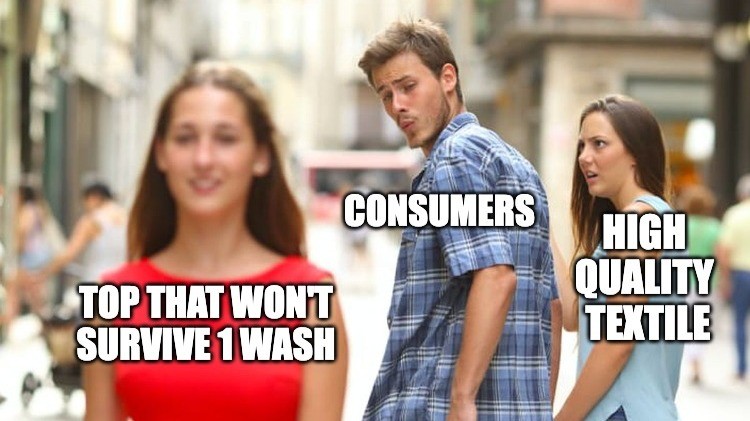
There’s a question I’ve been sitting with lately:
When did we collectively decide that “good enough, but effortless” beats “excellent, but requires something of you”?
Because if you look at how consumers actually behave — not what they say in surveys, but what they do with their wallets — the answer is: every single time.
Convenience doesn’t just compete with quality. It devours it. Quietly, comfortably, and with our full permission.
Let me show you what I mean.
Your Morning Coffee: A $10 Billion Downgrade
The Keurig K-Cup is not great coffee. Consumer testing consistently finds that drip brewers produce better-tasting coffee than most pod machines. The pods use pre-ground coffee that may sit sealed for months before reaching your kitchen. The brew cycle is too short for proper extraction. And you’re paying significantly more per cup — some estimates put K-Cups at up to four times the cost of ground coffee brewed in a standard drip machine.
And yet.
Forty percent of American coffee drinkers owned a single-serve brewing system by 2020 — up from the low teens in 2012, according to National Coffee Association data. The US coffee pod market hit an estimated $9.6 billion in 2025. Keurig shipped 10.4 million brewers in 2024 alone, up 7.3% year-over-year.
Even Keurig’s co-inventor, John Sylvan, has publicly said he regrets creating K-Cups because of the environmental waste they generate.
But consumers don’t care. Because the K-Cup eliminated every point of friction in the coffee ritual: no measuring, no grinding, no waiting, no cleaning. Press a button, coffee appears. The quality gap is real. The convenience gap is bigger.
Your Dinner: Delivered Worse, Blamed on the Restaurant
Here’s something that should make every restaurant owner lose sleep: according to industry surveys, most customers blame the restaurant — not the delivery app — when food arrives cold, late, or wrong.
Food delivery apps have fundamentally rewritten the rules of the restaurant business. Research from Wharton’s Manav Raj found that the emergence of delivery platforms “significantly increases the likelihood of restaurants closing their doors.” Commission fees of 15–30% per order are crushing margins. And a Stanford-affiliated study suggests that roughly half of every delivery dollar cannibalizes existing in-restaurant dining rather than representing new sales.
But here’s the convenience trap: once a consumer experiences the zero-friction version of dinner — browse, tap, wait on couch, eat — going back to getting dressed, driving, parking, waiting for a table, and driving home feels like an unreasonable ask.
The food isn’t better delivered. It’s often measurably worse. Temperature drops. Presentation suffers. The experience of dining vanishes entirely. But friction dropped to zero, and that’s all that mattered.
US third-party food delivery spending at quick-service restaurants tripled between late 2019 and late 2022, from $0.4 billion to $1.4 billion per quarter, according to USDA Economic Research Service data. The convenience flywheel is spinning, and quality is caught underneath it.
Your Closet: Designed to Be Disposable
Clothing today is worn just 7 to 10 times before being thrown away — a decline of more than 35% in roughly 15 years, according to research cited by the Ellen MacArthur Foundation and Earth.org.
Fast fashion didn’t just make clothes cheaper. It made them disposable by design. Shein released roughly 315,000 new items in 2022 alone, according to NielsenIQ analysis. What H&M offers over several months, Shein produces in days. Many items cost less than a latte.
And consumers know the quality is poor. A study by France’s ecological transition agency Ademe found that only about a quarter of Shein shoppers consider the product quality acceptable — and the numbers are even lower for platforms like Temu and AliExpress.
But they keep buying — because the friction of looking fashionable dropped to nearly zero. No store visit, no fitting room, no investment decision. Scroll, tap, wear once, discard.
Convenience didn’t just lower the quality bar in fashion. It eliminated the concept of quality as a consideration altogether.
Your Music, Your Movies, Your Books
The pattern is everywhere once you start looking.
The CD outsold vinyl in six years — not because it sounded better (audiophiles will argue it didn’t), but because it removed every point of friction: no flipping sides, no scratches, no needle replacements.
Then MP3s killed CDs with objectively worse audio quality — lossy compression literally removes parts of the sound file. But a thousand songs in your pocket? The convenience gap was insurmountable.
Streaming killed MP3 ownership. Lower audio quality on standard tiers, buffering, no permanent collection. But zero effort to access virtually all music ever recorded.
The same arc played out in video (VHS beat Betamax, streaming is beating Blu-ray), in reading (e-books and Kindle changed how millions consume books, despite the loss of tactility), and in photography (phone cameras largely replaced dedicated cameras for most people, despite inferior image quality, at least in some cases).
Every single time: worse product, less friction, convenience wins.
The Pattern: What Convenience Actually Sells
After 25 years of studying consumer behavior across industries, here’s what I’ve come to understand:
Convenience doesn’t sell a better product. It sells the absence of stress.
Every friction point — driving somewhere, choosing between options, waiting, maintaining equipment, cleaning up — is a micro-decision that costs cognitive energy. Every micro-decision is a tiny stressor. And in a world where consumers are already decision-fatigued, exhausted, and overstimulated, the product that eliminates the most stress from someone’s day wins. Not the product that performs the best.
This is why K-Cups win despite worse taste. This is why delivery apps win despite worse food. This is why fast fashion wins despite worse quality. This is why streaming wins despite worse fidelity.
Consumers weren’t choosing worse quality. They were choosing less stress. And for decades, less friction meant less stress. Full stop.
But Here’s What Nobody’s Talking About…
Convenience won. Decisively. Across every category.
But something interesting is happening at the edges.
Vinyl outsold CDs again in 2022 — for the first time since the 1980s. Independent bookstores have been growing year after year, with store counts at their highest levels in over a decade. Film photography is surging among Gen Z. Cinema attendance is rebounding despite living rooms that increasingly rival the theater experience.
Consumers are starting to choose friction again — on purpose.
Not because they want worse convenience. But because convenience, in winning the war against quality, accidentally killed something else: the feeling that an experience matters.
Convenience reduced the stress. But it also reduced the joy.
And that tension — between effortlessness and meaning — is exactly where the next era of brand strategy lives.
Hamutal (Tula) Schieber is the author of The Joy Dividend: How Brands Win by Reducing Stress and Sparking Delight, founder of Schieber Research, and a keynote speaker.