What This Sunday’s $7M Super Bowl Ads Reveal About Your Brand
Every February, brands now spend around $7–8 million for 30 seconds of airtime. Most treat it as a gamble. Smart strategists treat it as the world’s largest live experiment in emotional marketing.
What makes the Super Bowl uniquely valuable as a research lab: 100+ million people watch the same ads, at the same time, in a heightened emotional state. Then we get real-time sentiment tracking, next-day recall studies, social engagement data, and eventually, sales impact analysis.
Translation: It’s a multi-billion-dollar A/B test on what actually creates emotional connection at scale.
Look across two decades of results, and a pattern emerges. The ads that drive business results—not just buzz—engineer joy with surgical precision. Underneath the chaos, the same levers show up again and again: stress-reducing humor, emotional proxies (yes, especially dogs), engineered surprise, and moments of belonging.
The 2025 Paradox: Emotional Masterpieces That Failed as Ads
Two major ad-testing platforms analyzed every Super Bowl LIX spot. Their findings reveal the most expensive lesson in advertising history.
System1’s verdict: 2025 delivered the highest creative quality in six years. Three ads hit the rare 5-star threshold for emotional engagement (Lay’s “Little Farmer” at 5.9, NFL “Somebody” at 5.6, WeatherTech at 5.2). Average score: 2.9 stars—the best since they started testing.
DAIVID’s verdict: 2025 scored 6.2 out of 10 on Creative Effectiveness—the lowest since 2020.
How can ads be simultaneously the most emotionally engaging AND the least effective?
Because brands forgot to brand.
System1’s fluency tracking (brand recognition) hit an all-time low: 21% of viewers couldn’t recall which brand paid for the ad they just watched. At $7-8M per 30 seconds, that’s millions spent making people feel something while forgetting to make them remember who made them feel it.
DAIVID’s analysis shows why: 76% of ads attempted humor, but 7 of the top 10 emotionally engaging ads were purpose-driven campaigns that sparked admiration (29.7%), hope (21.4%), and warmth (21.4%). Brands chased emotion—and succeeded. They just forgot to attach their name to it.
The brutal lesson: You can create a cinematic masterpiece, engineer perfect neurochemical responses, make people cry or laugh—and still completely fail as advertising.
Which brings us to the principle: Make them laugh, but make sure they remember you.
The Four-Pillar Pattern Hidden in Plain Sight
Pattern #1: Strategic Humor (Not Just “Funny”)
Across Super Bowl and brand-lift studies, humorous ads tend to outperform serious ones on likability, recall, and short-term purchase intent—but they often underperform on clear messaging when the joke overwhelms the brand. The neuroscience is simple: when an ad is easy to process and emotionally positive, your brain encodes it faster and remembers it longer.
Look at the top comedy spots in USA Today’s 2025 Ad Meter rankings: Uber Eats, Bud Light, and others leaned into simple, visual humor you can “get” in half a second. Your brain doesn’t have to work hard; it just gets a fast, pleasant jolt, and that pleasant association sticks to the brand.
The caveat: Humor alone fades fast. The 2025 winners who used comedy—like Lay’s “Little Farmer”—stacked it with emotional depth, scoring 5.9 stars on System1 (the highest ever recorded). Comedy gets attention. Emotion creates memory.
The takeaway: Humor isn’t entertainment. It’s a stress-reduction mechanism that makes your brand feel safe, simple, and worth remembering. Just don’t rely on it alone.
Pattern #2: Emotional Proxies (Kids and Puppies?)
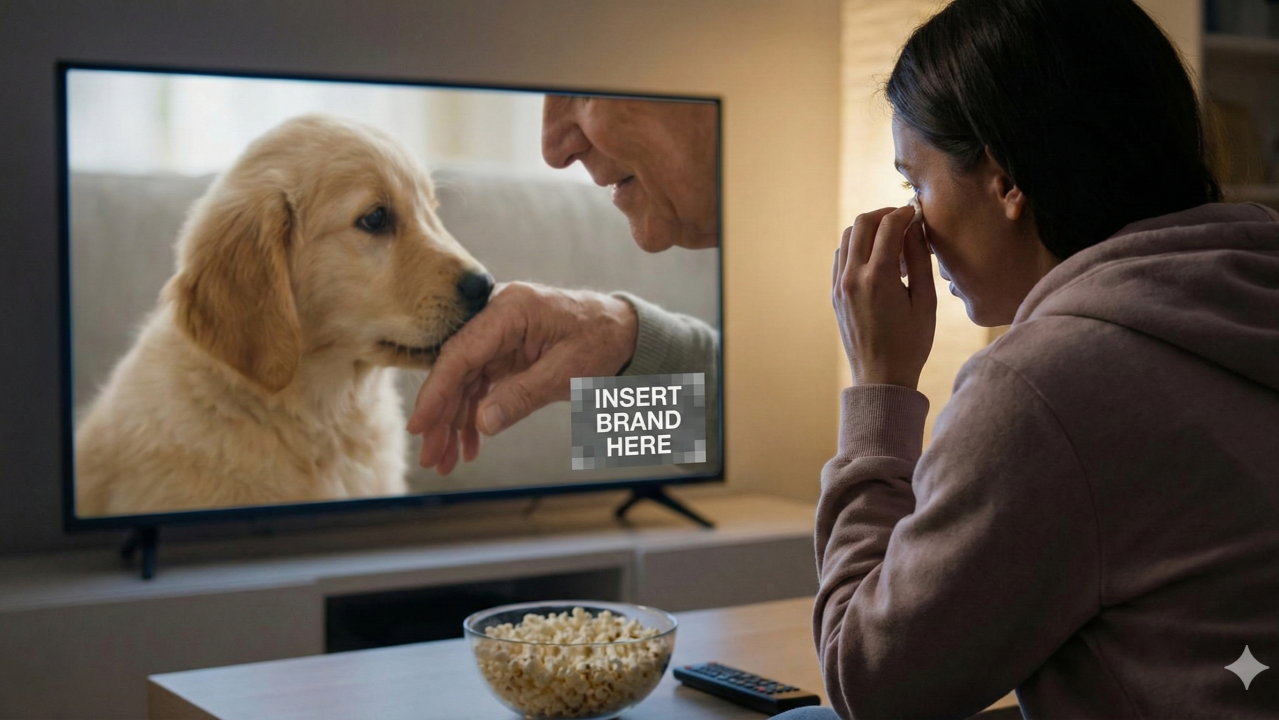
Dogs and other animals have become one of the most reliable emotional shortcuts in modern advertising. Academic research on “animals in advertising” consistently finds that the presence of a dog increases heuristic processing (fast, feeling-first thinking), boosts positive attitude toward the ad, and can lift purchase intention. Studies show that people form trust-based, attachment-style relationships with pets, and that pet imagery can transfer that sense of unconditional trust and warmth to brands.
Why does this keep working at scale? Because overt human intimacy in ads often feels manipulative or staged. But a puppy with an expressive face, or a horse nuzzling its trainer, becomes a proxy for trust and bonding that your brain accepts without the same skepticism.
The takeaway: If you can’t engineer authentic human connection (and at scale, you usually can’t), find your brand’s emotional proxy—often an animal, sometimes a kid, sometimes nostalgia—that can safely carry warmth and trust for you.
Pattern #3: Engineered Surprise (Water Cooler Fuel)
The ads you remember on Monday morning all have one thing in common: an unexpected moment that demands to be discussed. Behavioral science calls this the Peak-End Rule: we judge and remember experiences mostly by their most intense moment and the ending, not by the average of the whole.
Volkswagen’s “The Force” (2011) didn’t just go viral; later analyses highlight how its single emotional peak—the kid “starting” the car—drove both recall and positive brand sentiment years beyond its media flight. This has become a superbowl all-time winner, and if you’ve never watched it, don’t miss it.
The takeaway: Your surprise moment should be so specific that people have to describe it to their friends—turning them into your unpaid marketing team and reinforcing the memory every time they retell it.
Pattern #4: Belonging > Awareness
The brands that treat Super Bowl ads as pure awareness plays are leaving money on the table. The smart ones use that cultural moment to signal: “You belong here.”
The NFL’s “Somebody | It Takes All of Us”scored 5.6 stars on System1 and achieved the highest emotional engagement of any 2025 Super Bowl ad.
Nike’s first Super Bowl ad in 27 years featured only women athletes—Sha’Carri Richardson, Caitlin Clark, A’ja Wilson, Jordan Chiles—with rapper Doechii narrating: Nike’s first Super Bowl ad in 27 years featured only women athletes—Sha’Carri Richardson, Caitlin Clark, A’ja Wilson, Jordan Chiles—with rapper Doechii narrating: “You can’t win? So win.“
Google Pixel’s 2024 “Javier in Frame” followed a blind man documenting his life—finding love, buying a home, becoming a father—using accessibility features narrated by Stevie Wonder. It drove 285+ million views and won the Kellogg School Super Bowl Review by normalizing disability while celebrating the universal desire to capture memories.
All leveraged the fact that we’re not just watching the game—we’re watching with everyone else. Research shows that perceived warmth often matters more than perceived competence when it comes to followership and loyalty. The ads that acknowledged the shared experience and reflected back a community people wanted to join earned emotional loyalty, not just name recognition.
The takeaway: Don’t interrupt the party. Become part of the reason people showed up—so choosing you feels like choosing a group identity, not just a product.The Joy Dividend vs. The Super Bowl Mistake
The Joy Dividend vs. The Super Bowl Mistake
The 2025 Super Bowl proved the Joy Dividend principles work—emotion drives measurable business outcomes. System1’s data confirms it: ads that reduced stress through humor, created connection through emotional proxies, engineered surprise moments, and fostered belonging scored the highest they’ve tracked in six years.
But here’s what the Super Bowl reveals that most brands miss:
The Joy Dividend isn’t about creating moments of emotion. It’s about building a systemthat ties those emotions to your brand so they compound over time.
Super Bowl advertisers treated emotion as a one-time stunt:
- Engineer a tearjerker moment (✓)
- Get people to feel something (✓)
- Assume that feeling transfers to your brand (✗)
The Joy Dividend treats emotion as a strategic framework:
- Engineer joy AND stress-reduction at every touchpoint
- Make your brand the consistent source of that relief
- Create a recognizable system (fluent devices, consistent tone, recurring rituals) so the emotion sticks to you
- Let it compound into lasting loyalty, not viral buzz that evaporates by Tuesday
The 2025 lesson: You can borrow the four patterns for a $7M ad and get 100 million people to feel something. Or you can build them into your brand DNA and make every customer interaction a dividend-paying moment.
21% of Super Bowl viewers couldn’t remember who made them laugh. Your customers should never have that problem.
What This Means for Brands Without a Super Bowl Budget
You’re thinking: “Great, but I’m not spending $7M on a single ad.”
Exactly. Which is why these patterns matter more for you. The Super Bowl just makes the principles visible at scale. But they apply to every customer touchpoint you own.
Monday Morning Exercise
Pick your most important customer interaction (your homepage, your onboarding email, your checkout flow, your booking or scheduling experience). Then score it on each pattern:
- Does it reduce stress or add friction? (Humor / ease—can you create even a small moment of lightness or relief?)
- Does it create emotional connection or feel transactional? (Emotional proxy—are you using cues that carry warmth and trust, like pets, kids, or familiar rituals?)
- Does it have a memorable moment or blur into sameness? (Surprise—one small Peak-End moment that people might mention or screenshot.)
- Does it create belonging or just push a transaction? (Community—does it signal “people like you are already here” or “you’re part of this”?)
Fix the lowest score first. That’s your fastest path to compounding joy and emotional loyalty. I even made a scorecard for you to use, based on Chapter 7 of my book!
Your Superbowl Assignment
Watch the ads with a strategist’s eye. Score each one:
- Humor: Does it make you smile—and does that smile make the brand feel safer and simpler to choose?
- Connection: What’s their emotional proxy—dogs, kids, nostalgia, found family, or a ritual everyone recognizes?
- Surprise: What’s the one Peak-End moment everyone will talk about Monday? Screenshot it.
- Belonging: Does it acknowledge the shared experience of watching together and invite you into a “we,” or does it just shout its name?
The ads that score high on 3+ dimensions? Those are your case studies. The ones that score low? Those are your cautionary tales. Either way, you’re watching the world’s most expensive focus group reveal exactly what creates emotional loyalty at scale.
The real question: What are you doing with that lesson on Monday morning?
P.S. If you want to go deeper on any of these patterns, I’ve mapped the research and plug-and-play frameworks in The Joy Dividend, so you can turn what you see on Sunday into concrete audits, experiments, and briefs next week instead of just “that was a good ad” vibes.
Originally posted on THE JOY DIVIDEDND LINKEDIN NEWSLETTER. Visit to view the ads mentioned here and follow for more.