Something interesting is happening in cities across the country – and the world. On Wednesday nights, strangers are meeting for dinner. Thousands of adults are waking up at 6 AM to dance sober before work. People are gathering in libraries and cafes to read silently together – no book discussions required.
Welcome to the era of the adult playdate.
It sounds silly until you see the revenue. Timeleft, a platform that matches strangers for Wednesday dinners, generates $10 million in monthly recurring revenue across 200+ cities. Les Amis, a women’s friendship app, hit 120,000 installs and 30,000 women have attended events to date. Silent Book Clubs have exploded to 2,000 chapters in 62 countries with events up 44% year-over-year. Collectively, a dozen friendship apps generated $16 million in U.S. consumer spending in 2025 alone, according to estimates from Appfigures.
This isn’t a wellness trend. It’s a structural response to a crisis – and it’s rewriting the rules of community and connection.
The loneliness epidemic is real—and friendship is the new priority
The youngest generations are struggling most. According to the 2025 Cigna Vitality Index, 67% of Gen Z and 65% of Millennials report feeling lonely—significantly higher than Gen X (60%) and Baby Boomers (44%). The health impacts are severe: chronic loneliness has effects equivalent to smoking 15 cigarettes daily. In 2023, U.S. Surgeon General Vivek Murthy declared loneliness a public health epidemic.
But here’s what makes this a brand story: these generations aren’t suffering in silence. They’re actively structuring solutions. And they’re willing to pay for help.
More striking: they’re prioritizing friendship over romance. YPulse’s 2024 research shows 58% of single 13-39 year-olds say “romantic relationships aren’t my priority right now.” Forty percent met their current partners through social media versus just 29% through dating apps. When Bumble For Friends reached 730,000 monthly active users and Hinge launched a $1 million fund for social groups, the message became clear: the market has shifted from dating-first to friendship-first.
Adults are essentially recreating the infrastructure of childhood friendship—scheduled activities, repeated exposure, shared goals—because that’s what actually works. They didn’t sit around having deep conversations about feelings as kids. They kicked a ball together, got paint on their hands, and friendship happened as a byproduct.
Turns out that model still works. Adults just needed someone to rebuild the infrastructure.
Enter “Fourth Spaces”
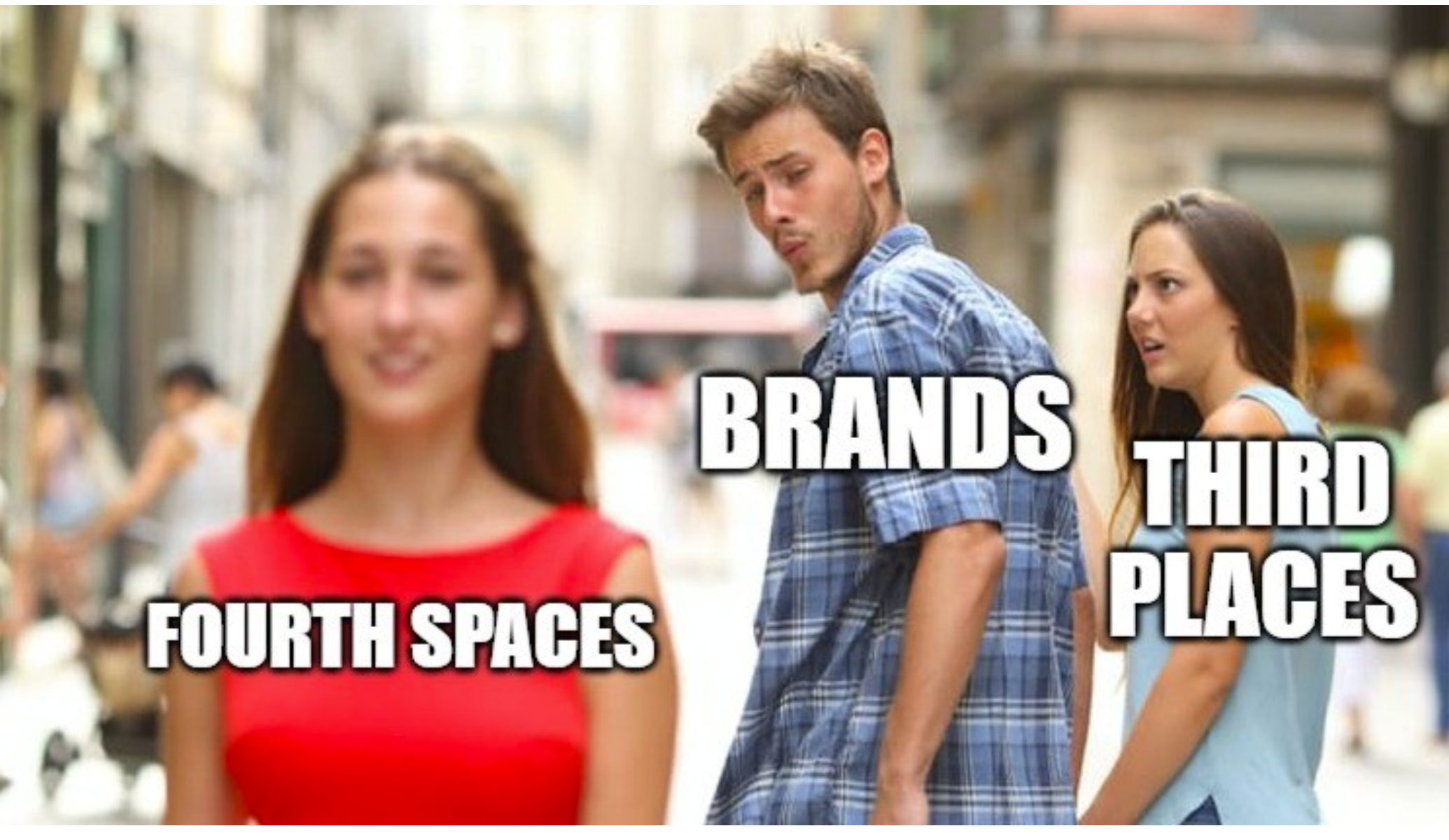
Eventbritereleased a brilliant report in January 2025 examining the growth of “Fourth Spaces”—gatherings that transform online interests into real-world connections. If home is the first space, work is the second, and public places like cafes are the third, Fourth Spaces are where identity and community form together through shared interests.
The data shows remarkable demand—and here’s where it gets interesting for brands. 95% of Gen Z and Millennials want to explore their online interests through in-person events. Not “might be interested.” Not “would consider it.” Actively want it. This isn’t a niche trend. It’s a structural shift in how younger generations are seeking connection. 79% are specifically drawn to events that blend multiple interests—not just cooking classes, but cooking classes with wine pairings and maybe some live music. Not just book clubs, but book clubs that meet for running tours through locations mentioned in that week’s book. (I highly recommend downloading the report for a deep dive into the trends!)
Critically, 84% of people who attend these interest-based events develop close friendships through them. These aren’t networking events where you collect business cards and never follow up. People are forming real relationships, and they’re doing it at scale.
Why structure enables connection: the neuroscience
There’s actual biology at work here. Social interaction triggers oxytocin release—often called the “bonding hormone”—which reduces cortisol (your stress hormone) and increases feelings of calm and connection. Research shows that oxytocin combined with social support produces the lowest cortisol levels along with increased calmness.
But here’s the critical part: the structure matters. Having something to do together – cooking, crafting, playing games – provides what researchers call “low-intensity sensory stimulation” that’s particularly effective for oxytocin release. The activity creates a focus outside yourself, reducing the social anxiety that keeps many adults from even trying to make friends.
The structure itself is the stress reducer. Knowing the format (Wednesday dinners, monthly book club, weekly craft night) eliminates the anxiety of “why hasn’t anyone texted me?” The activity provides a conversational buffer – you can talk about the recipe, the book, the game instead of forcing intimate disclosure. And the repeated exposure creates familiarity without pressure.
Once you’ve reduced the anxiety through structure, you can build the real opportunity: personalized belonging.
Community & connection: where personalization meets belonging
This is the heart of The Joy Dividend framework I outline in my book – and it’s what makes Fourth Spaces different from every other community-building attempt in the past decade. These platforms aren’t creating generic gatherings. They’re engineering personalized belonging at scale.
Les Amis is the perfect example of this evolution. Founded in 2022 by Anna Bilych (ex-PayPal) after struggling to make friends while relocating for work, the women’s friendship app launched in Europe and debuted in the U.S. in Austin (April 2025) and New York ($70/month, August 2025). The platform uses AI to match women every Monday based on age, location, career stage, relationship status, and interests – then connects them to curated local events like pottery classes, book clubs, wine tastings, and Pilates. In less than three years, they’ve hit $1 million in annual revenue with 120,000 installs and 30,000 women attending events.
The personalization isn’t algorithmic gimmickry. It’s about finding “your people” through shared micro-interests. Not just “book lovers” but “people who want to read literary fiction while eating cheese.” Not just “runners” but “runners who want to discuss true crime podcasts while jogging through historic neighborhoods.” The specificity is the point.
Timeleft takes a different approach but with the same underlying principle. They match six strangers for Wednesday dinners using a personality algorithm – participants know only zodiac signs and job industries until 24 hours before meeting. The platform handles restaurant selection, time, and matching. Your only job is to show up. That elimination of decision fatigue and social risk is worth €10 million in annual recurring revenue to them across 200+ cities.
Daybreaker exemplifies the synchronized connection model. They throw sober, high-energy dawn dance parties (starting at 6 AM with group yoga) in 30+ cities globally. Over 500,000 members have joined since 2013. Co-founder Radha Agrawal says, “When you come to a Daybreaker event, what you’re actually getting is 10 years of therapy in three hours” – referring to the emotional openness that dancing together unlocks. Neuroscience backs this: dancing or singing in unison spurs oxytocin release, strengthening connections to others.
The strategic implication for CMOs
The scale is remarkable. Escape rooms have grown into a $9-10 billion global market. Board game cafés are proliferating worldwide, contributing to a board game market approaching $20 billion. Sober morning raves, silent reading circles, craft nights, running clubs – the variety is endless, but the pattern is consistent: structure reduces anxiety, specificity enables belonging, and belonging drives revenue.
This trend reveals something important about consumer psychology in 2025. Your customers – especially younger ones – are experiencing genuine emotional pain (loneliness, isolation, anxiety) and they’re actively seeking solutions. They’re not embarrassed about needing help. They expect brands to acknowledge that adulting is hard and that making friends after college requires intentionality.
The opportunity isn’t to “fix” loneliness. It’s to provide the infrastructure that makes connection easier.
This is exactly what I mean by The Joy Dividend: brands that understand the emotional job-to-be-done and systematically remove barriers win the loyalty and premium pricing that comes from genuine emotional value.
Ask yourself: Could your brand facilitate Fourth Spaces? Not through heavy-handed corporate events, but by reducing friction and enabling personalized belonging?
If you’re a food brand, could you create dinner party kits with themed menus, Spotify playlists, and conversation starters that make hosting feel accessible? If you’re in beverages, could you sponsor local supper clubs with signature cocktails and help them grow through infrastructure support? If you’re in crafts or hobbies, could you provide everything needed for a “craft night party” so the host doesn’t have to overthink it?
The companies capturing this market aren’t creating new needs. They’re identifying existing emotional jobs-to-be-done (I need to make friends, I need community, I need to feel less alone) and building elegant systems that reduce every barrier. They’re applying the core principle: calm the anxiety first, then enable the connection through personalization and specificity.
Remember: these aren’t products. They’re permission structures. You aren’t selling a pottery kit; you are selling a permission slip to play. They are infrastructures for oxytocin release. They are containers for belonging.
Your customers are literally scheduling playdates. The question is whether your brand will help them build the personalized communities they’re craving, or watch someone else do it.
The brands that figure out how to facilitate this kind of hyper-specific belonging – not through algorithms alone, but through structured, repeated real-world experiences – will own the next decade of customer loyalty. This is what Community & Connection means in 2025.
Pssttt… The Joy Dividend is coming out January 1, 2026 and the ebook is already available for pre-order. Stay tuned!