Most brands measure what their customers did. Repeat purchase, basket size, conversion, NPS. What almost no one measures is what their customers felt while doing it — and that gap is the most valuable thing a brand can learn to see.
I call the thing on the other side of that gap the Joy Dividend: the compounding return a brand earns when it deliberately reduces stress and engineers delight across the customer journey. Not the marketing kind of delight. The structural kind — whether the lighting in the store welcomes you or wears you down, whether the checkout feels like a goodbye or an extraction, whether the loyalty program makes you feel recognized or merely processed. These small emotional transactions never show up in a quarterly dashboard. They show up two years later, in who stayed and who quietly drifted.
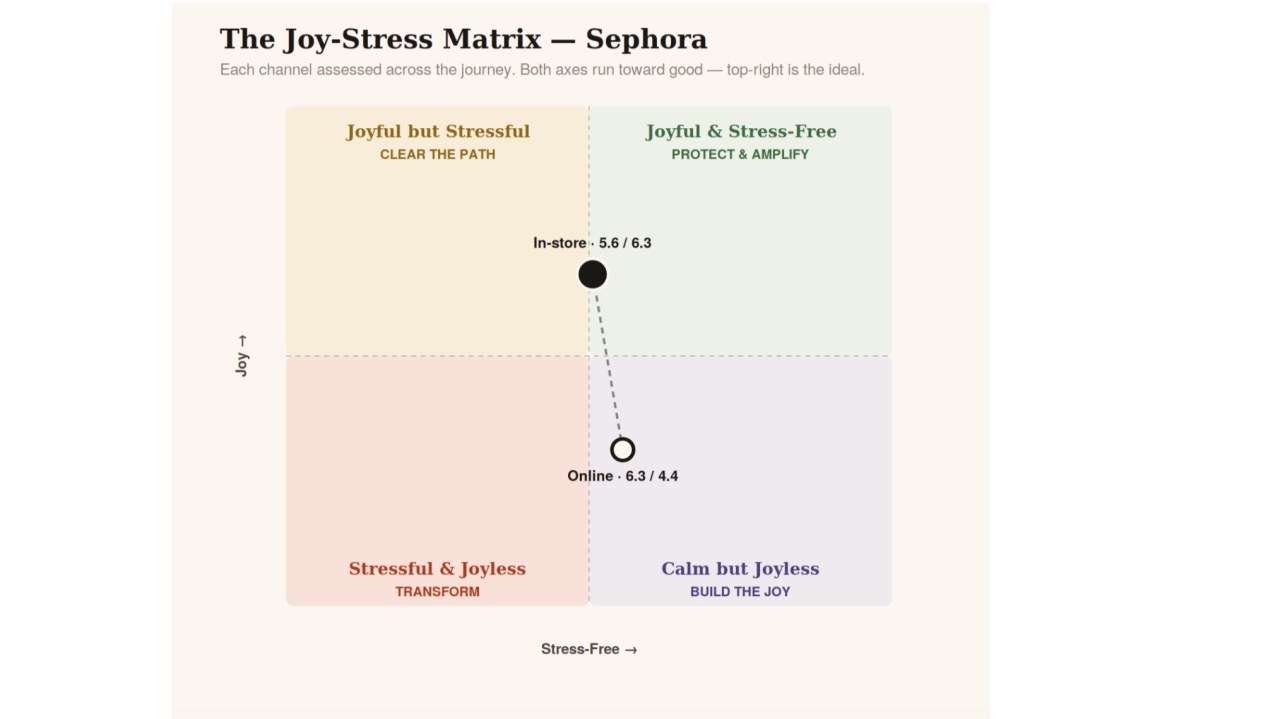
To make that gap visible, I run a Joy-Stress Audit: a scan of every customer-journey touchpoint on two separate dimensions — how stress-free it is, and how much joy it delivers. The two are not the same thing, and keeping them apart is the whole point. A moment can be perfectly smooth and completely forgettable. It can be delightful and exhausting at once. When you score stress and joy as the distinct things they are, and plot the average, a brand lands in one of four quadrants: Joyful & Stress-Free (the ideal), Joyful but Stressful, Stressful & Joyless, or — the quiet trap — Calm but Joyless.
I ran it on the brand having the loudest year in beauty retail. Sephora's 2025 was, by every public measure, a strong year — market-leading growth, North America out in front, Hailey Bieber's Rhode launching as the biggest brand debut in the company's history at roughly $15 million in its first days, around a hundred new stores, a loyalty program at record membership. By the dashboard, nothing is wrong.
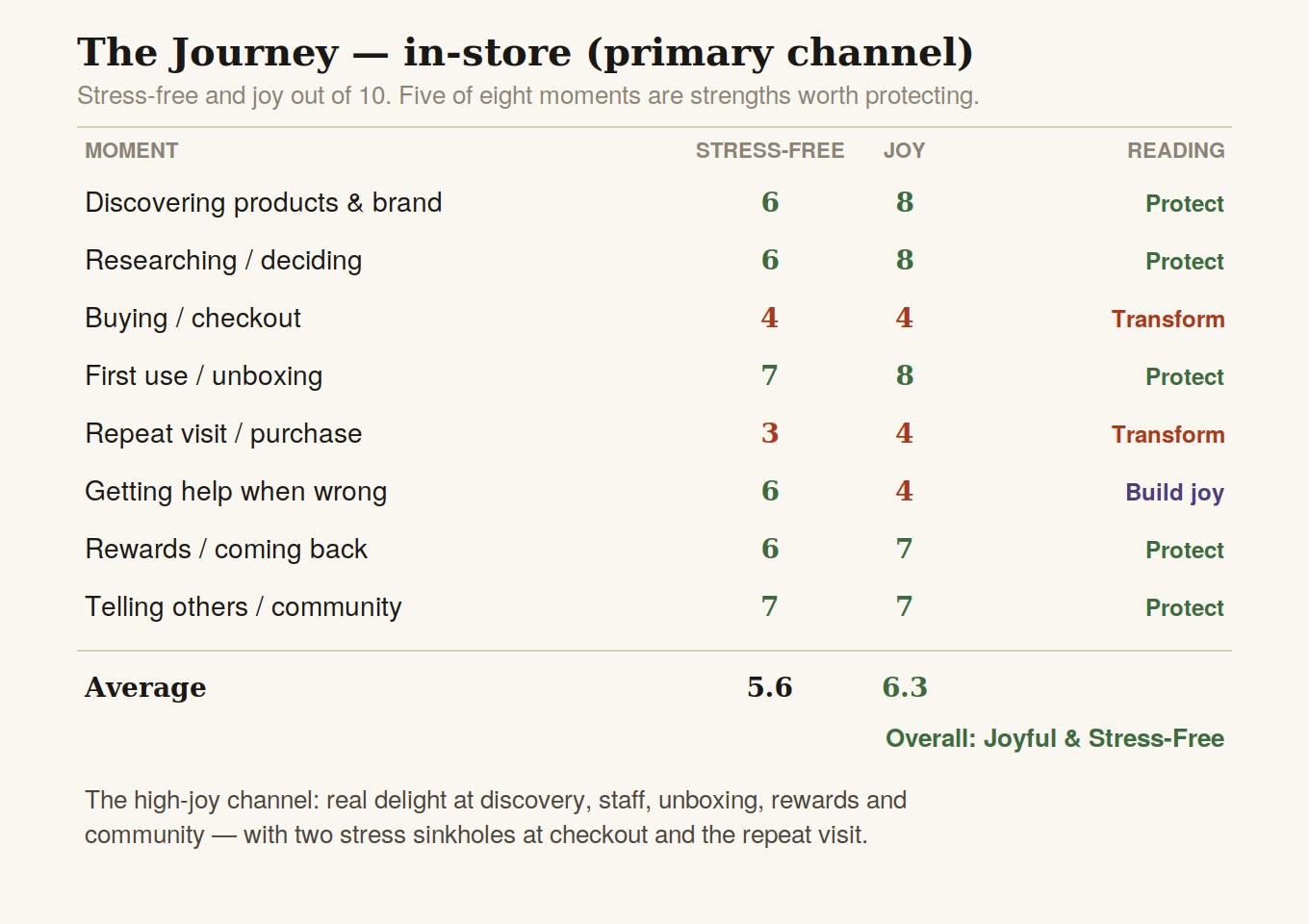
And that's exactly what the audit is built to question. Because when I assessed Sephora's two channels across the journey, they landed in different quadrants — and not the ones you'd guess. In-store came out Joyful & Stress-Free: the ideal. The delightful channel, the one worth protecting. Online came out Calm but Joyless — smooth, easy, low-friction, and almost entirely without delight.
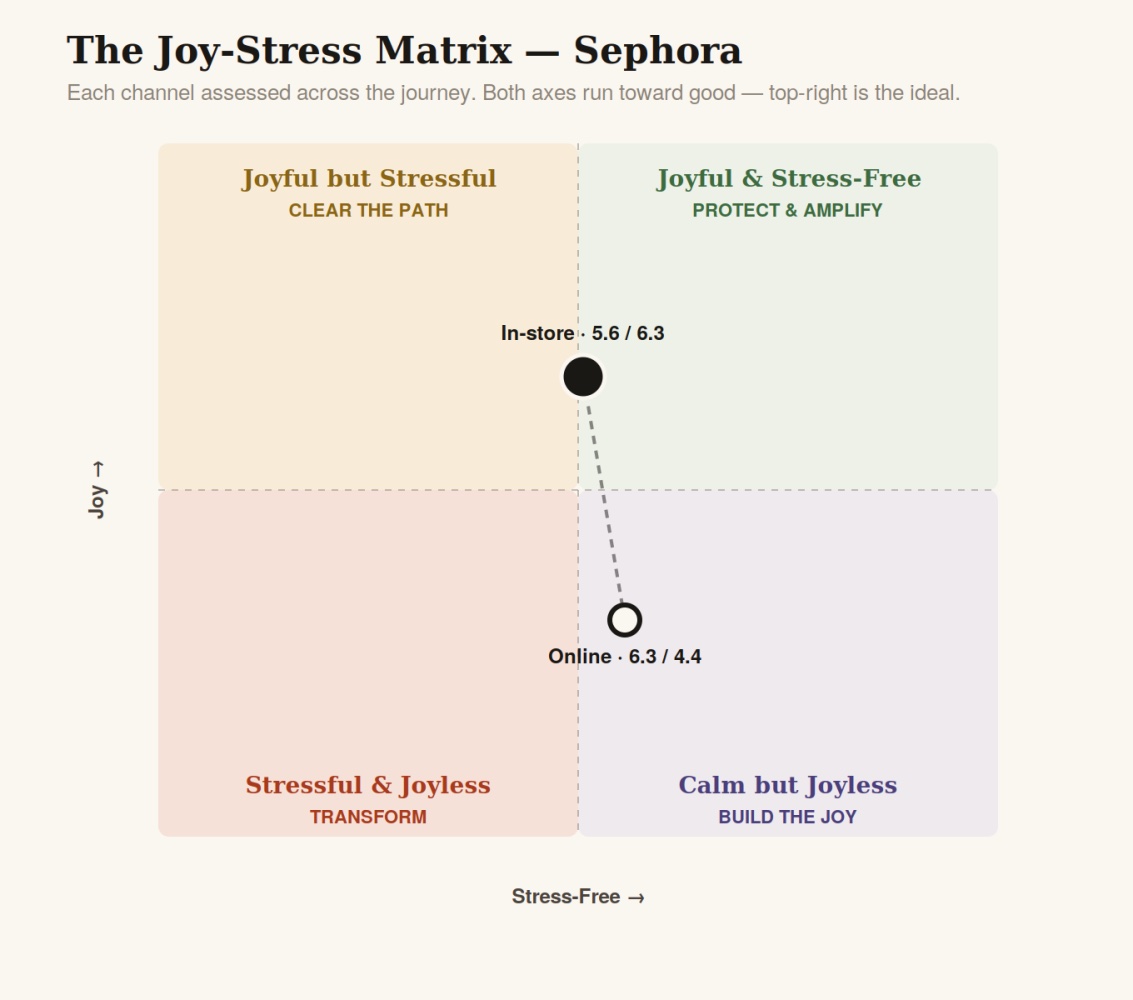
That second finding is the one worth sitting with, because it's the one the numbers hide — and because what you do about it is a real strategic choice, not a foregone conclusion. Almost everything customers praise about shopping Sephora online is the absence of stress, not the presence of joy. The app is easy to navigate. Free shipping with no minimum is best-in-class. Ingredients are easy to find. All real — and all calm, not joy. Online scores well on stress-free almost everywhere you look. It just never makes anyone smile.
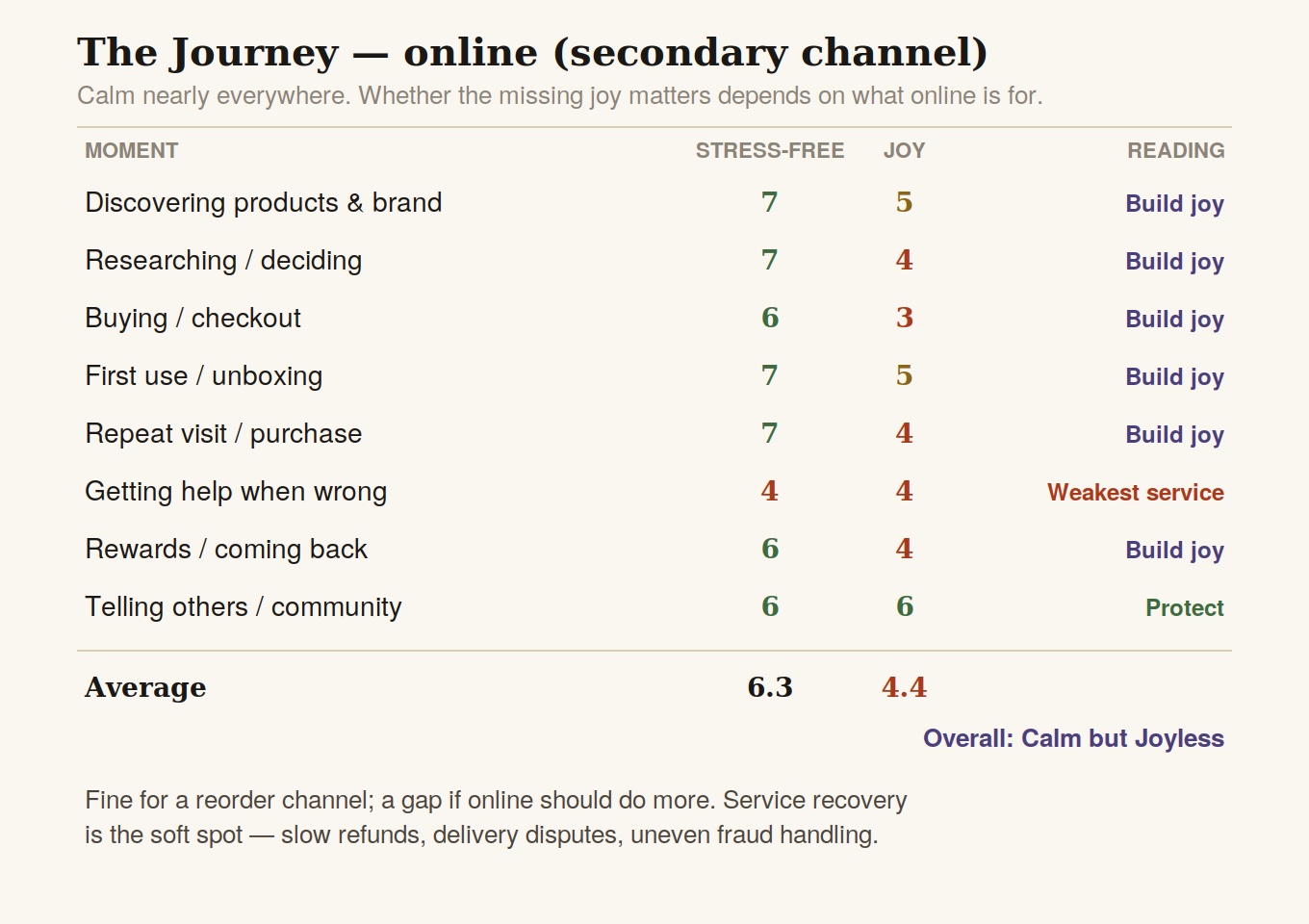
And here's where I'd resist the obvious conclusion. Online is not Sephora's core channel; the store is. So a calm, frictionless, undelightful online experience might be exactly right — for a utility, reorder-driven channel, nobody needs to be dazzled buying a refill of something they already love. Calm but Joyless could be a brand correctly spending its joy where joy matters most: on the floor. By that reading, it's not a gap at all.
It becomes a missed dividend only under one condition: if Sephora wants online to do more than fulfill. To win the customer who shops digitally first and may never set foot in a store. To keep the relationship warm in the long stretches between visits. To compete with the brands that are making online itself feel like an event. Whether Calm but Joyless is a destination or a gap depends entirely on what you've decided the channel is for — and that's the conversation the audit is built to start, not to end. The framework brings the question mark; the strategist brings the answer.
Here's why that should make a CMO lean in rather than wince.
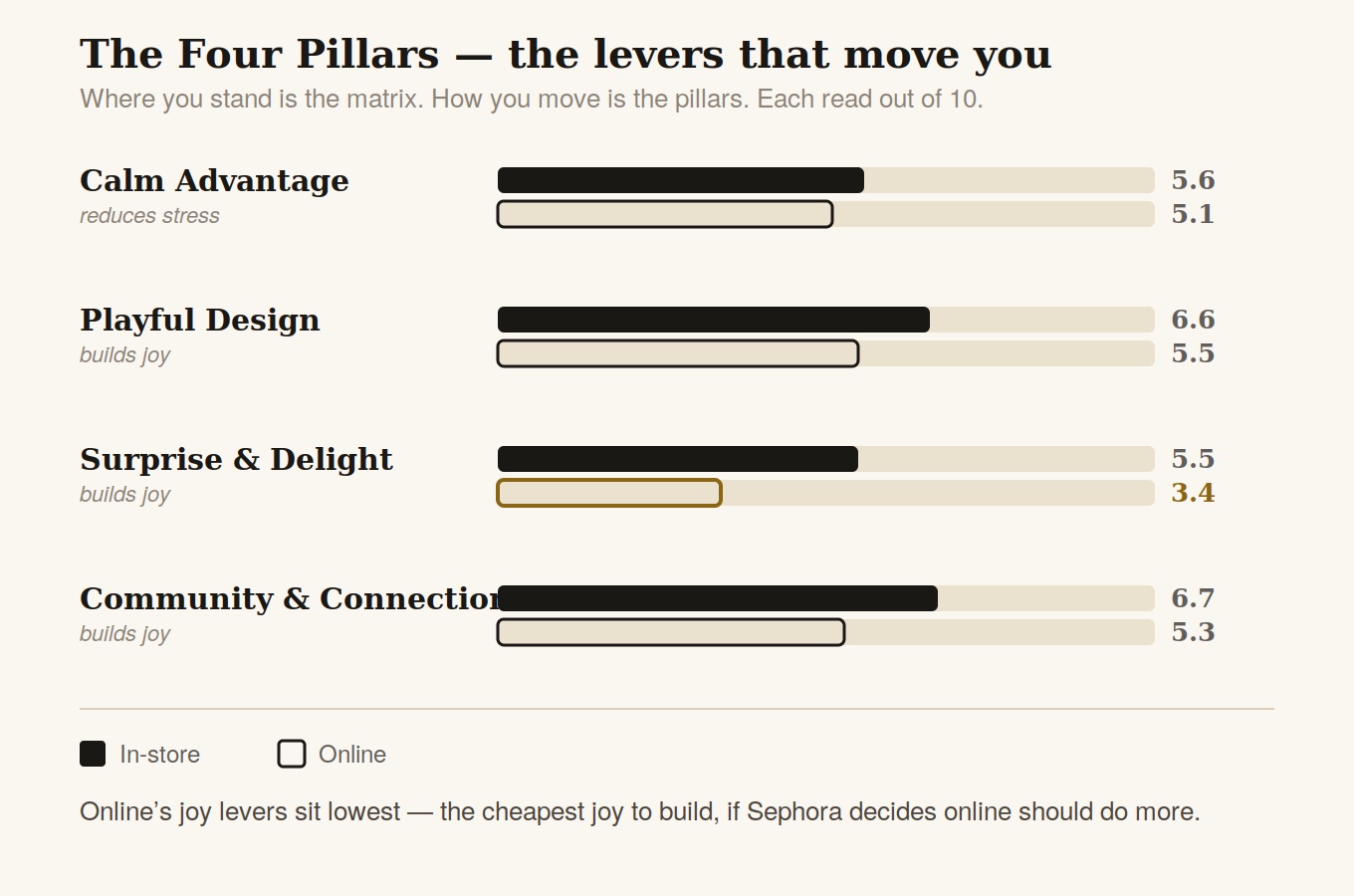
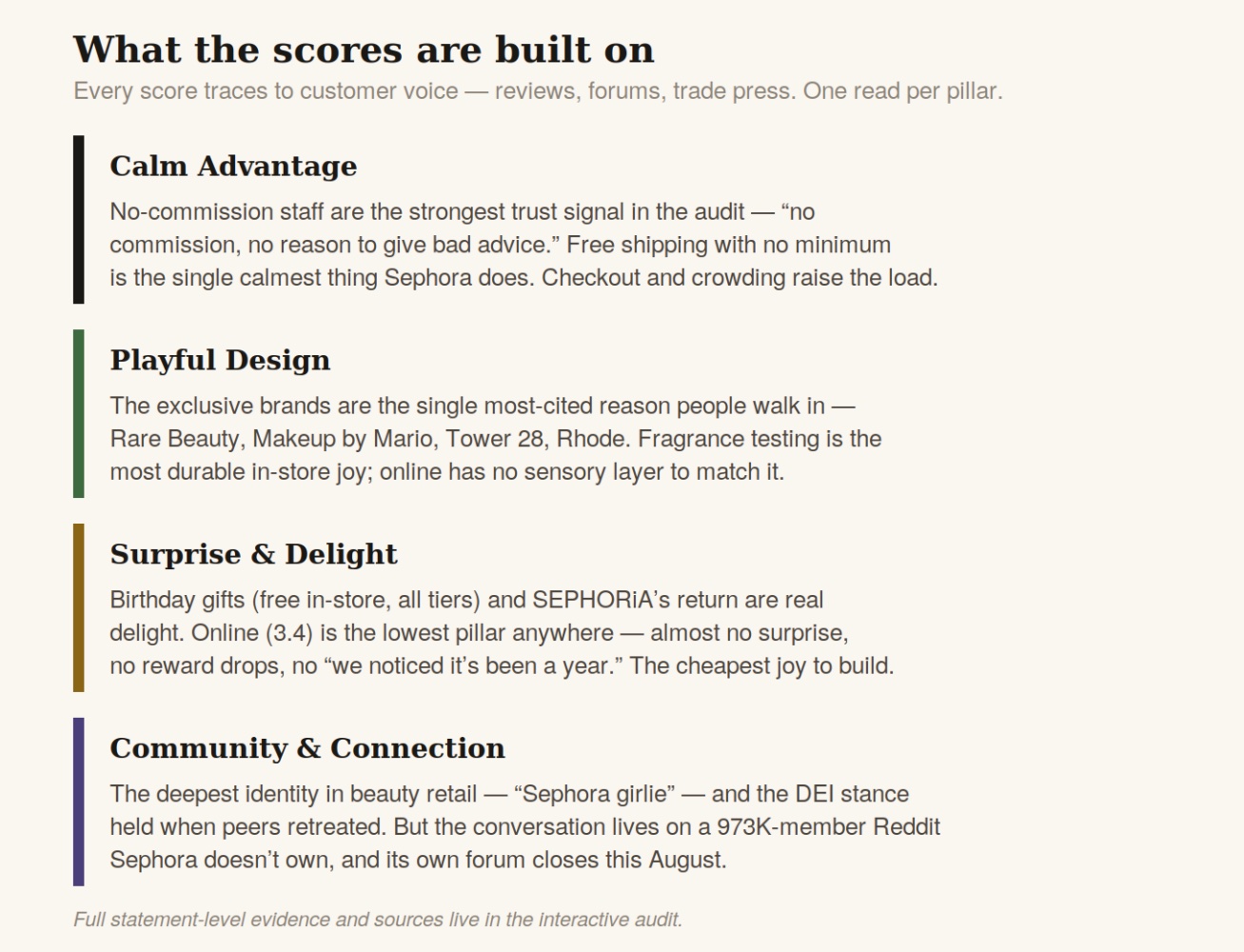
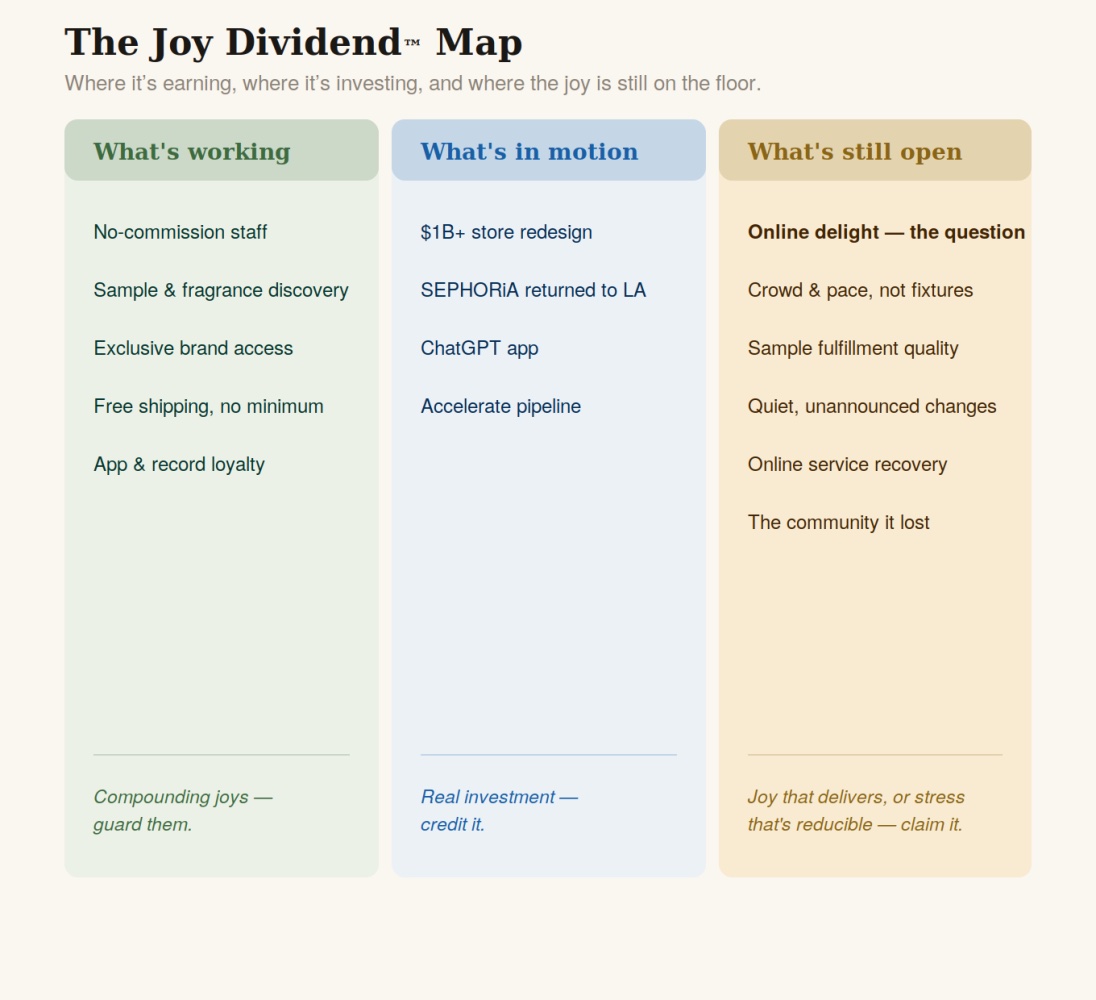
In-store is where the joy genuinely lives, and Sephora should guard it. The staff don't earn commission, and the customers who notice say it changes everything — they trust the recommendations precisely because the associate has no reason to upsell them, and there's a well-documented pattern of staff steering shoppers toward cheaper or even competitor products. The sample culture lets you try before you commit. The fragrance ritual is something a screen structurally cannot reproduce. The exclusive brands — Rare Beauty, Makeup by Mario, Tower 28, Rhode — are the single most-cited reason people walk in. These are compounding joys: the kind that build loyalty rather than rent it.
And Sephora is not asleep. It has read several of its own signals and is spending serious money against them. The billion-dollar store redesign, the largest capital project in its history, is rebuilding the floor with better lighting and more private service spaces. SEPHORiA, the flagship fan event, returned to Los Angeles this past March for the first time since 2019. The ChatGPT app is a real bet on conversational decision support. Credit where it's due: a lot of the right work is in motion


The opportunity online, then, is conditional — and that's what makes it interesting. If Sephora decides online should do more than fulfill, joy is the one thing it's missing, and online joy is the cheapest joy on the entire map to build. In-store crowding is hard and slow to fix; online delight is engineerable in an afternoon. A genuine surprise sale. A members-only reward drop. An unboxing that feels like a gift instead of a shipment. A "we noticed it's been a year" moment. Almost no retailer does this, and Sephora has the loyalty data to do it better than anyone. The channel that scores lowest on joy is also the one where joy is cheapest to claim — whenever the brand decides it wants to.
One online weakness, though, holds under any strategy: service recovery. When something goes wrong online, getting it fixed is the weakest part of the experience — refunds run slow, lost-delivery disputes leave customers feeling unsupported, and the fraud picture cuts both ways. Customers hit by account or gift-card fraud find resolution uneven; gift-card cases in particular get routed to a third-party processor with little remedy. And in the other direction, some legitimate orders get caught in anti-fraud flags and cancelled with accounts placed "under review" — which stings most for the longtime members it occasionally catches. It's a recurring theme across the Better Business Bureau, Reddit, and even local news — a real pattern, though returns and delivery complaints are more frequent. A reorder channel is allowed to be undelightful. It still has to fix things when they break.
The rest of the open opportunities are quieter, and they're mostly about stress nobody is removing. The sample program — the single most-cited reason customers feel Sephora helps them decide — survives as a policy but is decaying in execution, with missing samples and substitutions one shopper called "the illusion of an option." The return window quietly tightened from sixty days to thirty with no announcement; customers found out at the register. And the fifteen-year Beauty Insider Community forum is closing this August, even as the conversation thrives on a Reddit community nearly a million strong — a place the brand doesn't own, can't shape, and can't learn from.


None of these are catastrophes. Every one of them is joy that delivers, or stress that's reducible, sitting on the floor.
That's the whole value of looking at a brand this way. Sephora's revenue is being carried by acquisition — new stores, viral launches, exclusive brands — and that's a real strategy that's working right now. But acquisition is a lever you have to keep pulling harder every year. The
Joy Dividend is the other lever: the joy that compounds, the stress you remove once and never pay for again. The audit doesn't tell Sephora it's losing — it isn't. It tells Sephora where the joy is: the joy it's built and is quietly letting slip, and the joy it has never reached on a channel it hasn't yet decided to invest in. What to claim, and where, is the strategic question. The audit just makes sure it's being asked.
That's what this instrument does. It doesn't tell you whether you're winning; your dashboards do that. It tells you where the joy is — the joy you've built and are letting slip, and the joy you've never reached at all — so you can decide what to claim next.
I run the Joy Dividend audit two ways. There's a digital version a brand can run on its own customers, scoring the journey moment by moment and surfacing its own map. And there's a full-day workshop, which is the deeper move — tailor-made, every time. I bring external customer research like the read behind this piece, set it alongside your own internal data, talk to your stakeholders where it helps, and we build the map together in the room: where you stand on the matrix, and which of the four pillars is the lever that moves you.
If you've ever suspected the gap between what your dashboards show and what your customers feel is wider than the dashboards admit — that gap is exactly what this is built to find. Comment or DM me if you'd like to see what it surfaces on your brand.
Originally published in The Joy Dividend on LinkedIn.