
Jaguar registered 49 cars across all of Europe in April 2025. Forty-nine.
eBay’s stunning new “Things.People.Love.” design system is winning admiration from the design community—while sellers on its forums call the rollout “the most inefficient change” yet.
And Airbnb just created one of the most brilliant brand extensions in recent memory—Experiences—while quietly shifting its language from “Belong Anywhere” to “book everything.”
Three brands. Three emotional rebrands. Three questions about what it actually takes to earn a Joy Dividend.
Jaguar: What If You’d Honored What a Century Built?
First, the context that makes this story more interesting than the headline. Those 49 registrations aren’t primarily a rebrand story—they’re a product gap story. Jaguar deliberately discontinued nearly its entire lineup through 2024: the XE, XF, F-Type, E-Pace, and I-Pace were all killed off, leaving only limited F-Pace stock.
By April 2025, there was almost nothing left to buy. The company was clearing the decks for an all-electric relaunch targeting the ultra-luxury segment at £120,000+, and managing director Rawdon Glover openly estimated that only 15% of current buyers would return.
But here’s what makes it a Joy Dividend story: Jaguar chose to sever the emotional connection at the same time.
In November 2024, alongside the product discontinuation, Jaguar retired its iconic leaping cat, replaced it with a minimalist wordmark, and launched the “Copy Nothing” campaign featuring abstract visuals and fashion models—but zero cars.
So during the most vulnerable moment in the brand’s history—when there was literally nothing on the lot—they also erased the emotional equity that was keeping people connected. Double vacuum: nothing to buy and nothing to recognize.
Observers called the new identity “cold and aloof” - the opposite of the warmth heritage is supposed to provide.
What if Jaguar had maintained the warmth of a century of heritage while the factory retooled?
eBay: What If Joy Felt the Same on Both Sides?
eBay’s five-year “Evo” brand system deserves real admiration. The tagline “Things.People.Love.” works beautifully on two levels—read it as a description (things that people love) or as three brand pillars. The 136-color accessible palette, card-stack layouts inspired by how customers actually browse, and the global “eBay Stories” campaign spotlighting real sellers’ passion stories —all of it signals a company trying to make commerce feel human again.
Through the Joy Dividend lens, eBay is activating Community & Connection (making sellers feel seen as passionate individuals, not transaction participants), Playful Design (discovery over shopping), and Calm Advantage (“humanizing and simplifying,” as head of design Aaron Carámbula put it).
But here’s the tension worth sitting with: eBay is a two-sided marketplace. Buyers and sellers. And right now, the emotional storytelling is largely facing outward—toward buyers, toward culture, toward brand perception. Meanwhile, sellers report that Evo-related workflow changes have added clicks, not removed them. Listing tools are harder to navigate. Changes roll out during critical Q4 selling season without warning.
What if “Things.People.Love.” applied to both sides of the marketplace? What if the seller dashboard felt as considered as the buyer storefront?
The Joy Dividend framework says emotional architecture has to be experienced at every touchpoint—not just the ones the customer sees, but the ones the people who make the customer experience possible see, too.
A brand can’t earn a Joy Dividend when only half the ecosystem feels it.
Airbnb: What If Your Most Brilliant Innovation Became the Blueprint for Everything?
Let’s start with what Airbnb got spectacularly right.
Experiences is one of the most creative brand extensions in recent memory. You take a booking platform and turn it into a portal for cooking classes in Tuscany, street art tours in Buenos Aires, truffle hunting with a grandmother and her dog. That’s not a feature add—that’s emotional architecture. It says: we don’t just give you a place to sleep, we give you a reason to go.
And the numbers back it up. The 2024 Icons campaign—the Up house, Prince’s Purple Rain home, an overnight at the Musée d’Orsay—generated a billion social impressions, 60 million site visits, and 1.7 million new user profiles, earning four Cannes Lions and 11 total creative awards.
In May 2025, the platform expanded to Experiences in 650 cities, Services across 10 categories, and a completely redesigned app.
By October 2025 guests could see who else was attending an Experience and message them afterward—turning bookings into the beginnings of relationships.
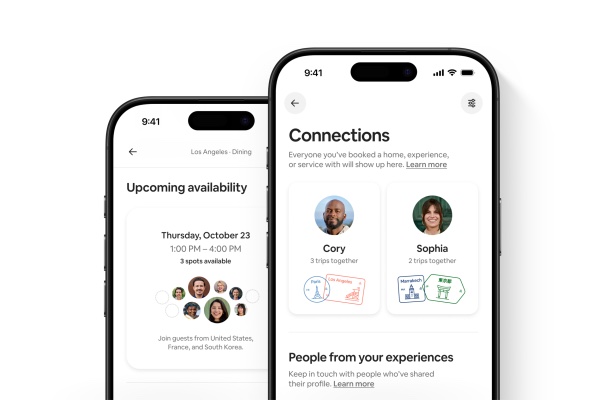
This is real emotional architecture. Surprise & Delight built into the business model. Community & Connection as a literal product feature. Playful Design in every ramen class and architecture tour. Brilliant.
But something interesting has happened in the space between the brand’s origin and its current trajectory.
Airbnb was born as “Belong Anywhere.” That was never a tagline—it was a worldview. It said: travel is about human connection. Strangers can become hosts. A city can become a neighborhood. You don’t just visit, you belong.
Today, the language has shifted. CEO Brian Chesky talks about building an “everything platform,” draws explicit Amazon analogies, and describes capturing “1.6 billion devices.” The 2025 launch tagline was “Now you can Airbnb more than an Airbnb”—a utility proposition. The new Services category—in-home chefs, massage, photography—is framed as competing with hotel amenities.
And it raises a question worth asking:
What if community wasn’t a product line—what if it was the operating system?
Think about what changes. Services, right now, means “book a massage at your Airbnb.” Hotel parity. A convenience play. But what if the massage therapist was Maria, who’s lived in Barcelona for 20 years and tells you where the locals actually eat? Same service. Completely different emotional frame. One reduces friction. The other creates connection.
Airport transfers are pure logistics. But what if the pickup was done by a local who gives you a 20-minute orientation to the city on the drive? Grocery delivery is Instacart with an Airbnb logo. But what if the order was curated by your host—“here’s what I’d cook if I were staying here this weekend”?
Airbnb’s Experiences proved that the community thesis works—and that it generates extraordinary brand value. The Joy Dividend is compounding in the core stays business while the newest extensions drift toward functional parity with the very industry Airbnb was supposed to be the alternative to.
What if you kept the thing that made you different—and let go of the race to match what everyone else already does?
Three Questions for the Emotional Economy
Each of these rebrands illuminates a different challenge in earning the Joy Dividend—and none of them are simple:
Jaguar asks: What if you’d maintained the warmth of a century of heritage—even while the factory retooled? Heritage is emotional capital. The hardest competitive advantage to replicate. During a product gap, it’s the only thing keeping people connected. Why sever it voluntarily?
eBay asks: What if you designed for the joy of both sides of your marketplace—not just the buyers? Emotional architecture has to be experienced at every touchpoint. When only half your ecosystem feels it, the promise fractures.
Airbnb asks: What if your most brilliant innovation became the blueprint for everything—not just one product line? Experiences proved that community and belonging create extraordinary brand value. What if that insight shaped every new service, every expansion, every touchpoint?
The pattern across all three: the Joy Dividend isn’t a campaign. It’s not a tagline. It’s not even a product feature. It’s an operating practice. Not perfectly, but intentionally.
The question isn’t whether your brand should compete on emotion. It’s whether emotion is your strategy—or your side project.
Hamutal (Tula) Schieber is the founder of Schieber Research and author of The Joy Dividend: How Brands Win by Reducing Stress and Sparking Delight. With 25 years of strategic research connecting consumer psychology, competitive best practices, and market intelligence, she helps companies understand what consumers actually want — not what brands wish they wanted. Book Tula to speak
📚 Get The Joy Dividend 🔗 Schieber Research 📬 hamutal@researchci.com
Hit "Subscribe" to get research-driven insights on consumer psychology and brand strategy every week.
Originally published in The Joy Dividend on LinkedIn.