Three years ago I argued in a Cambridge handbook that brand-side NFTs would fail. They did. Now the same mistake is queued up with AI — and the diagnostic is the same.
In 2023, I contributed the consumer-behavior chapter to the Cambridge Handbook of Law and Policy for NFTs, edited by Prof. Nizan Geslevich Packin. The handbook is mostly law — securities regulation, anti-money laundering, copyright, taxation. My chapter, Power to the People: Consumers, NFTs, and Marketing in Pursuit of a Decentralized World, was the consumer voice in a room full of legal scholars.

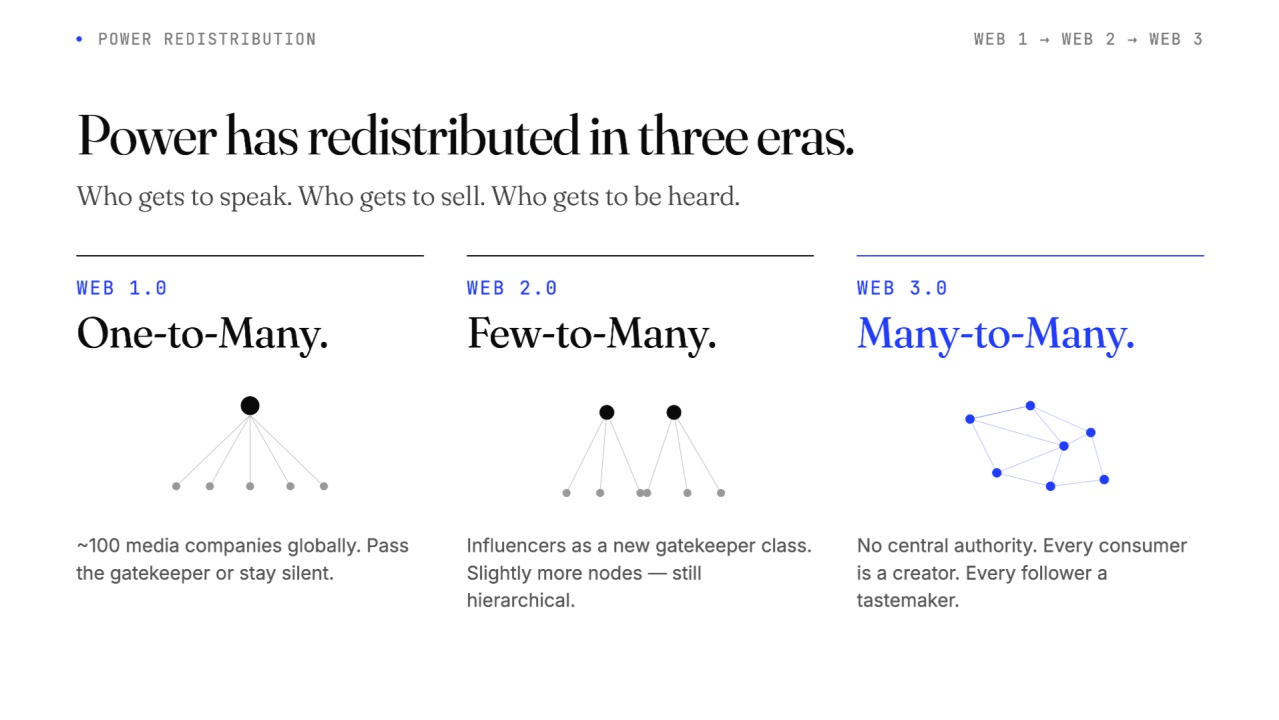
The argument was straightforward. Brands were rushing into NFTs because they had identified a real consumer trend — the generational appetite for decentralization, identity, and Many-to-Many connection — and were responding to it with precisely the wrong instrument. They were taking a tool that could enable peer-to-peer ownership and creator empowerment, and using it to do the opposite: artificial scarcity, status hierarchies, and financial speculation.
I argued the projects would fail.
On Friday, I returned to Prof. Packin's Sharing Economy and Digital Platforms class to talk about what's happened since. The deck is below. The receipts are sobering. And the reason I'm writing this on a Monday morning is because the same mistake is about to play out with AI avatars and synthetic creators — for the same structural reason — and most brands are sleepwalking into it.
The receipts
Starbucks Odyssey, the NFT-backed loyalty program, was shut down in March 2024 after roughly 18 months. The post-mortems pointed to complexity, friction, weak engagement (~58,000 active users, most of whom didn't understand what a wallet was), and — most damning — no clear why. Customers wanted a discount on their Frappuccino. They got a Web3 quest.
Nike acquired RTFKT for a reported figure approaching $1 billion in late 2021, at the peak of the bubble. By April 2025, the average Cryptokick had collapsed from roughly $8,000 at peak to about $16. The platform was shut down in January 2025. Three months later, a class-action lawsuit was filed in EDNY accusing Nike of operating a "soft rug pull" and selling unregistered securities. In December 2025, Nike quietly sold what was left of RTFKT to an undisclosed buyer for an undisclosed price.
Bored Ape Yacht Club — the cultural symbol of the entire bubble — peaked in April 2022 with a floor price around $429,000 per NFT. Today's floor sits around $24,000. A roughly 94% wipeout. The market is thin, the celebrity endorsements are gone, the Otherside metaverse is mostly vapor, and Yuga Labs has sold off most of its other ventures.
Microsoft saw all of this clearly in July 2022, before most brands had processed what was happening, when it banned NFTs from Minecraft. The statement is worth quoting because it diagnoses the entire failure in twelve words:
"NFTs create a scenario of the haves and the have-nots, inconsistent with the long-term joy of our players."
Haves and have-nots. The exact opposite of what consumers were running toward.
The diagnostic
The 2023 chapter argued that the failure was not technological. The blockchain rails worked. The economic concept of programmable royalties and verified ownership was sound. The failure was strategic. Brands deployed a decentralization technology against the values of the consumer it was supposed to serve.
Here's the operative rule, stated plainly: technology fails when brands deploy it against the values of the consumer it's meant to serve. It succeeds when it disappears behind existing behavior.
The proof of the inverse is sitting in plain sight, just under different vocabulary. Singapore Airlines' KrisPay tokenizes airline miles on a blockchain back-end and never says the word "NFT." Boba Guys' Passport program mints purchase stamps on Solana, signs you up with a phone number, and never asks you to manage a wallet. Visa launched a Web3 Loyalty Engagement Solution in 2024 — interactive, gamified, real-time — with the chain entirely invisible to the consumer. Mastercard, Ripple, and Gemini ran a 2025 pilot settling card transactions in regulated stablecoins on a public blockchain.
Same rails. Same programmable infrastructure. Stripped of the speculation, the status hierarchy, the custodial wallets, and the toxic word. The result: it works.
Why this matters for AI
AI is the next test of the same rule, and most brands are about to fail it the same way.
The 2026 forecasts are pointing the same direction: the first major brand sponsorship of an entirely synthetic creator — an AI-generated personality with no human behind it — is expected this year. Some platforms are explicitly building tooling for AI-creator businesses. The economics are seductive: synthetic creators don't burn out, don't demand equity, post in fifty languages simultaneously, and never have a bad day.
The economics are also a near-perfect repeat of the NFT mistake. Brands are about to deploy an extraordinarily powerful technology against the value most central to the consumer they are trying to reach.
That value is verifiability of humanness.
The Gen Z trust thesis is well-documented and stubbornly consistent across every study since 2020. They trust regular people more than celebrities. They detect inauthenticity instantly. They silently disengage from anything that feels manufactured. The entire reason creators displaced traditional advertising is that creators are visibly, idiosyncratically human in a way mass media stopped being a generation ago.
A synthetic creator is the inverse of that proposition. It is the most efficient possible delivery mechanism for the marketing industry's worst instinct: the polished, frictionless, optimized, soulless content that consumers have been migrating away from for fifteen years. It will work for some brands in some categories — performance marketing, low-consideration purchases, pure efficiency plays. It will fail spectacularly in any category where trust is the actual product.
My prediction: just as organic became a premium label in food after factory farming scaled, verifiably human will become a premium label in content as synthetic creators scale. C2PA already has the technical bones for human-content certification. The bifurcation is coming. Mass-produced synthetic content at the bottom — cheap, infinite, optimized for algorithms. Verifiably human creators at the top — uncopyable, premium. The middle gets squeezed.
The Joy Dividend frame
The four levers I write about in the Joy Dividend — Calm, Play, Surprise, Connection — are not abstractions. They are operationally what's missing from every brand deployment that fails.
NFT projects were not calm (confusing wallets and gas fees), not playful (financial speculation), not surprising (cynical drops priced for status), and certainly not connecting (status hierarchies that rewarded the haves at the expense of the have-nots). Synthetic creators, deployed without restraint, will fail the same four tests — particularly Connection, which is the entire point of a creator-fan relationship in the first place.
The brands that will win the next decade are not the ones with the most aggressive technology adoption. They are the ones that ask, before deploying any new tool, the simplest possible question:
Does this reduce stress and create joy for the consumer, or does it transfer stress to them in service of our efficiency?
That's the question every marketing leader should be asking before deploying any new technology. The 2026 receipts are what happens when you don't. The 2027 receipts will be the same — under different vocabulary — unless brands learn the pattern.
Power, again, to the people.
The talk I gave at Prof. Packin's class on Friday can be found here. It expands this argument with the full creator-economy framework — including how MrBeast, of all people, is currently navigating the verifiably-human bar in real time.
The original chapter, "Power to the People: Consumers, NFTs, and Marketing in Pursuit of a Decentralized World," is in The Cambridge Handbook of Law and Policy for NFTs, edited by Prof. Nizan Geslevich Packin (Cambridge University Press, 2024).
Originally published in The Joy Dividend on LinkedIn.