Gen Z just invented a new word for living like your grandmother.
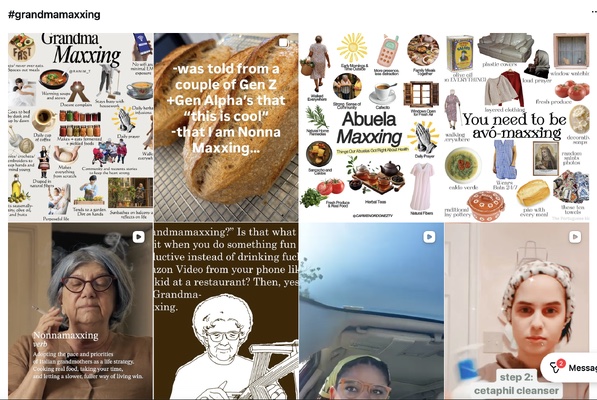
They're calling it nonnamaxxing — nonna, the Italian word for grandma, plus the "-maxxing" suffix born in the darkest corners of internet hustle culture. Looksmaxxing. Moneymaxxing. The language of relentless optimization.
And the most digitally native generation in history is using it to describe... crocheting. Slow-cooking soup. Walking to the market. Drinking coffee without answering emails.
They took the language of hyper-optimization and applied it to its opposite.
Nonnamaxxing is a specific set of choices gaining real traction: cook from scratch with seasonal ingredients, learn an analog hobby, stay embedded in your community, embrace aging instead of fighting it.
That isn't a lifestyle trend. It's a trust migration.
Think about what this generation was promised. Wellness apps to fix their sleep. Productivity tools to organize their lives. Longevity supplements backed by biohackers and podcasters. Algorithmic feeds that would show them exactly what they needed to see. An entire industrial complex built on the idea that human life could be optimized if you just downloaded the right thing, tracked the right metric, bought the right supplement.
After all of that — the cold plunges, the $200 adaptogenic mushroom blends, the work hard play hard — the most aspirational lifestyle they can imagine is the one their grandmother was already living.
She was walking 10,000 steps before anyone counted them. Eating seasonal before it was a diet. Present before mindfulness was a subscription. Cooking for her family before meal kits turned it into a logistics problem.
The wellness industry spent decades and billions of dollars trying to crack the longevity code. The answer was sitting at a kitchen table in Sardinia the whole time, chopping vegetables and telling you to eat.
What makes nonnamaxxing different from every previous wellness trend is that it's not asking you to add anything. It's asking you to stop. Stop optimizing. Stop tracking. Stop performing self-care for an audience. The most radical act in the trend barely registers as an act at all: sit outside. Drink your coffee. Be bored for a minute.
If you've been reading this newsletter, you've watched this signal build. The search for friction. The joy of missing out. The analog cameras merchandised at Urban Outfitters like artifacts from a calmer civilization. Pinterest, a social media platform, launching a campaign that tells its own users to put their phones down and go outside.
Nonnamaxxing is the same signal. Bigger. It's not a purchase. It's not an app. It's an entire generation trying to reverse-engineer a way of life that institutions and technology promised to improve upon and arguably made worse.
And this bridge actually works both ways.
The National Gallery of Art in Washington handed a script full of Gen Z slang to Alison Luchs, a 77-year-old curator who has worked at the museum for 47 years and speaks five languages. She approached the assignment the way she'd approach any translation project. She memorized the words, learned the pronunciation, and delivered it in one take.
"Chat, peep this bussin clay dish from the 16th century," she said, pointing to a piece of Italian maiolica. "Look how bro glazed it. He went goblin mode with all these colors."
The video became the most-watched post in the museum's history. Nearly nine million views across two videos. Hundreds of submissions poured in for a contest she promoted. Comments from people saying the videos helped them through a tough time, or made them want to visit a museum for the first time.
She wasn't performing youth. She wasn't trying to be relevant. She was doing what she's done for 47 years — sharing her collection — just in a language she hadn't spoken before. The sincerity is why it worked.
These two stories are mirror images of each other. In one, the youngest generation adopts the rhythms of the oldest. In the other, the oldest generation learns to speak in the language of the youngest. The direction doesn't matter. Both work only when the exchange is real.
The generational walls are coming down. Not because marketers engineered it, but because people on both sides are tired of the same thing: institutions that optimize for engagement instead of meaning, systems that measure everything except whether anyone actually feels better, and a culture that confused speed with progress.
Your grandma - doesn't matter if she's Nonna, Abuela, Babushka, Halmoni, or Savta - didn't need a whoop to tell her to go to bad early and didn't need a campaign to eat real food. Calm was a way of life, not an app. And marketers need to take note.
If you're wondering what your customers are maxxing for let's talk: hamutal@researchci.com
My book The Joy Dividend published January 1, 2026.
More strategic research every Monday—subscribe here.
Originally published in The Joy Dividend on LinkedIn.