Sometimes, you don't mind a line at all.
A new restaurant with a crowd out the door? You're more intrigued, not less. A pop-up with a wait? That's social proof. If you've ever walked past a line in New York and felt the pull to join it before even knowing what it was for — you know what I'm talking about. Lines can signal value.
But other times, a line is just something standing between you and the thing you already paid for. The airport. The clinic. The concert entrance. The DMV.
And then there's Chick-fil-A.
Chick-fil-A consistently has among the longest average drive-through wait times in fast food — often over eight minutes, with more cars in line than any other chain. They also have the highest customer satisfaction in the industry, scoring 98% in the 2025 QSR Drive-Thru Report.
The longest line. The happiest customers.
They're not an anomaly. Disney runs two-hour lines that guests describe as highlights of their trip. Houston Airport eliminated a flood of baggage complaints without speeding up a single bag. Starbucks didn't try to eliminate the wait — they made it visible, trackable, and ritualized.
Something deeper than speed is at work. And once you see the pattern, you can't unsee it.
The formula hiding inside every great line
In 1984, Harvard's David Maister published a paper that still quietly governs every well-designed queue on earth. His formula:
Satisfaction = Perception − Expectation
Both sides can be managed independently of how long the wait actually is.
The research since has only gotten stronger. A hospital study found that actual wait duration had far less impact on patient satisfaction than perceived and expected waits, which explained most of the variance. Kahneman's peak-end rule confirmed it from a different angle: people judge experiences disproportionately by their most intense moment and their ending, often underweighting total duration.
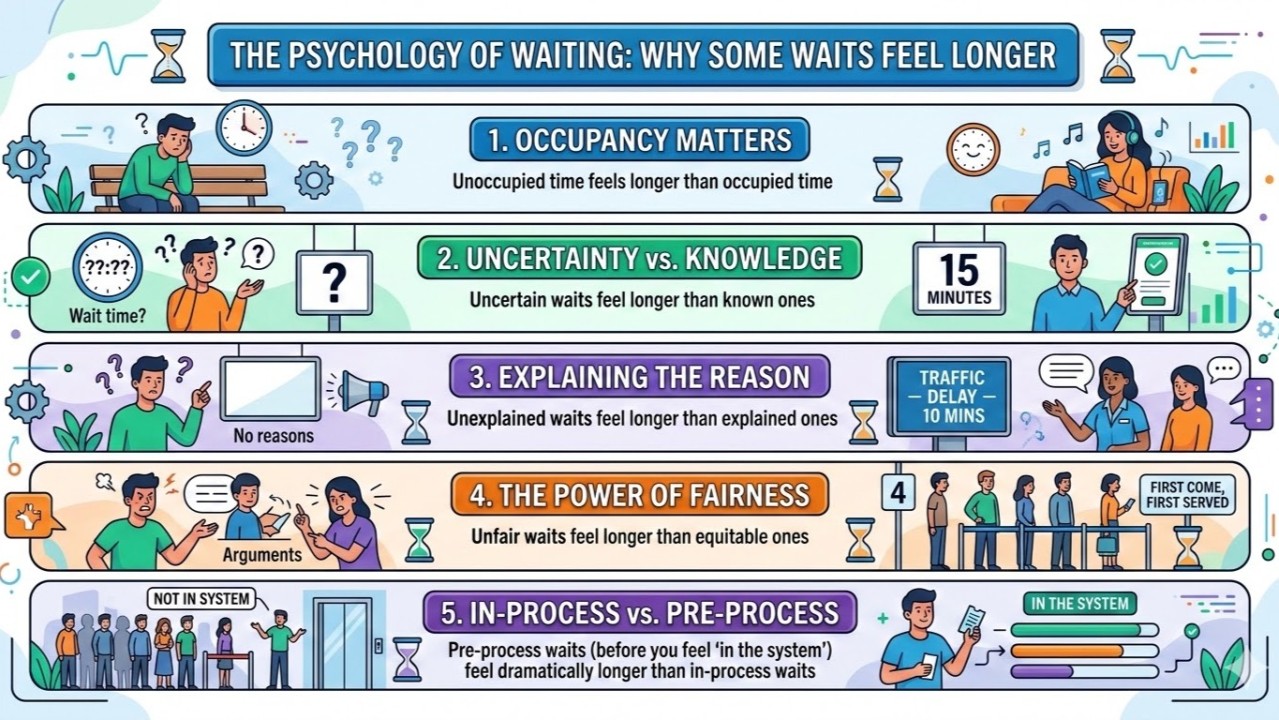
Maister's specific levers:
- Unoccupied time feels longer than occupied time
- Uncertain waits feel longer than known ones
- Unexplained waits feel longer than explained ones
- Unfair waits feel longer than equitable ones
- Pre-process waits (before you feel "in the system") feel dramatically longer than in-process waits
Every one of these can be pulled without changing the actual wait time. Here are five companies that figured this out — and what they're really doing beneath the surface.
1. Houston Airport: The walk that solved everything
Years ago, passengers at Houston Airport complained bitterly about baggage wait times. Analysis showed they walked one minute from the gate to the carousel, then stood idle for seven. The fix: reroute them on a six-minute walk to a farther carousel. Idle time dropped to two minutes. Complaints fell to near zero. Total time unchanged.
What I find fascinating here is that they tried the obvious solution first — more baggage handlers, faster processing — and it barely moved the needle. The problem was never speed. It was seven minutes of standing still with nothing to do.
Maister principle: Occupied time feels shorter than unoccupied time.
2. Disney: The queue IS the ride
The line for Star Wars: Rise of the Resistance walks you through a Resistance base, into a shuttle launch, and onto a Star Destroyer with 50+ Stormtroopers. Guests can't tell where the queue ends and the ride begins. Wait times routinely exceed two hours. Satisfaction stays high.
Disney also plays a subtler game. Studies have found that actual waits at Disney parks are often substantially shorter than posted times — frequently around half to two-thirds of what's listed. That's not an accident. By systematically overestimating, Disney ensures the final moments deliver a pleasant surprise. You arrive sooner than promised. The ending rewrites the memory.
That's Kahneman's peak-end rule, deployed at scale.
Maister principle: The queue doesn't have to be separate from the experience. It can be the first chapter of the story.
3. Chick-fil-A: The person who walks to your window
This is the one that made me rethink everything I assumed about speed.
Chick-fil-A's secret is called "Face-to-Face Ordering." Employees carrying tablets walk the drive-through line, taking orders through car windows. You see a human. You're greeted. Your order is in the system before you reach the speaker box.
What's happening psychologically? The moment someone approaches your window, your wait shifts from pre-process (waiting to be noticed) to in-process (being served). Maister's research is clear: pre-process waits feel dramatically longer because there's an underlying fear of being forgotten. A human showing up eliminates that fear instantly. The line hasn't moved. But your experience of it has transformed.
Maister principle: Pre-process waits feel dramatically longer than in-process waits.
4. Texas Roadhouse: Twenty million dollars in peanuts
Texas Roadhouse reportedly spends around $20M a year on free peanuts — buckets placed in waiting areas, shells thrown right on the floor.
It sounds like a quirky brand detail. It's actually a masterclass in queue psychology. Cracking shells gives your hands something to do (occupied time). The communal mess creates a shared, participatory atmosphere (solo waits feel longer than group waits). And the ritual signals that the experience has already begun — you're not waiting for dinner, you're at dinner.
The lesson isn't "buy peanuts." It's that a small sensory ritual at the point of maximum friction can rewrite the emotional story of the entire wait. It doesn't have to be expensive. It has to feel like it belongs.
Maister principle: Occupied time + the shift from pre-process to in-process.
5. Starbucks: Making the wait visible
Speed still matters at Starbucks — research shows that getting an order in under five minutes significantly boosts intent to return. They haven't solved the wait by slowing it down.
But they've done something interesting with whatever wait remains: they've made it legible. The mobile order tracker shows exactly where your drink is in the queue. The open bar lets you watch baristas work. Your name gets called.
I noticed this recently — the screen behind the counter showing order status in real time. It's a small thing. But it converts an uncertain wait ("did they forget me?") into a known, finite one ("I'm third in line, my order is being prepared"). And Maister's research is clear that uncertain waits feel dramatically longer than known ones.
The ritual doesn't replace speed. It reduces the stress of whatever wait remains. The theater of visible craft — the steam, the pour, the name call — isn't inefficiency. It's a signal that what you're getting required care.
Maister principle: Uncertain waits feel longer than known waits. Make the process visible.
The Joy Dividend Queue Framework
Across all five stories, a clear pattern emerges. None of these companies won by making the line faster. They won by redesigning what the line feels like — pulling specific psychological levers that transform waiting from a tax into a brand moment.
Those levers map to four categories:
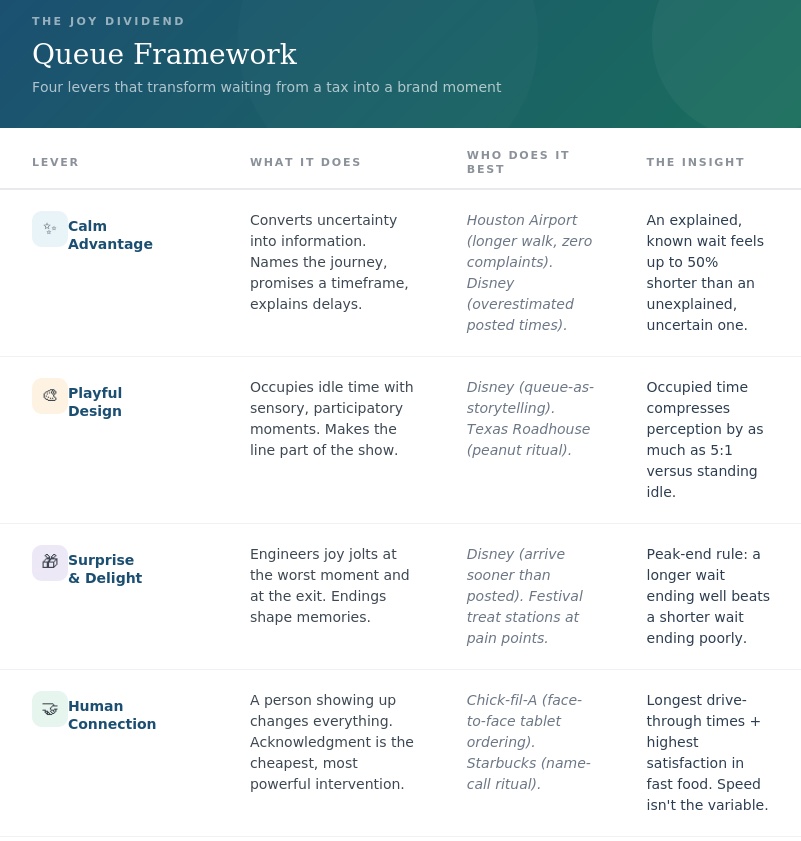
The most powerful experiences pull multiple levers at once. Disney combines three. Chick-fil-A layers two. The combinations compound.
Three things this research changed for me
1. Speed alone doesn't win. Chick-fil-A proves it — the longest wait, the highest satisfaction. What matters more than duration is whether people feel seen, informed, and occupied while they wait.
2. Longer can be preferred — if the ending is right. Kahneman's peak-end research shows that a longer queue ending well beats a shorter one ending poorly. Disney's overestimated wait times are a deliberate application of this.
3. The cheapest fix often works best. Houston's solution cost virtually nothing — just a longer walking path. Amazon invested hundreds of millions in Just Walk Out technology before scaling it back in many locations. The psychology is often cheaper than the engineering.
One question for your next queue:
Where in your customer journey do people wait — and what would it take to make that moment feel like proof of value instead of a tax?
The queue is not a necessary evil. It's a canvas.
The wait, done right, is the product.
Hamutal (Tula) Schieber is the author of The Joy Dividend: How Brands Win by Reducing Stress and Sparking Delight and founder of Schieber Research. She advises brands and leadership teams on designing high-joy, low-stress customer journeys. Book her to speak at your next company event.
Originally published in The Joy Dividend on LinkedIn.