
Last week I took a taxi, and the driver — an older man — started talking to me about joy.
“I used to love going to the bank,” he said. “I’d talk to the teller. I’d meet people. Now you have to use the app. I still love the supermarket — I get the best produce, and the people know me. My daughter, she orders food, she orders groceries, everything delivered. Why? Because it lets her work more.”
Is this a life-stage thing, I wondered out loud. I have kids. I run a business. I work out. I don’t want to spend two hours at a bank for something that takes ten seconds on my phone.
“That’s fair,” he said. “But your generation doesn’t understand. This isn’t what life was for us. We worked until four, and then the time was ours — free time to kill. We took things easy. Now you always rush. Exactly because you don’t need to rush anymore.”
I’ve written before about the paradox of free time — how we become restless precisely when we no longer have to spend ourselves on the mundane. But the driver was pointing at something underneath that.
He isn’t nostalgic for waiting.
He’s nostalgic for the contact the waiting smuggled in.
That distinction is the whole thing, and it is easy to miss. When we optimized the bank into an app, we told ourselves we were removing a chore. We were. But the chore was carrying something.
The line at the teller was a standing appointment with other people that nobody had to schedule. The trip to the supermarket was a reason to leave the house and be recognized. The friction was real, and annoying, and we were right to resent it — but some of it was load-bearing.
We threw out the package to save the postage.
The Time We Gained
“Did technology give us more time or less?” may be the wrong question.
It gave us more.
Economists Mark Aguiar and Erik Hurst examined five decades of American time-use data and found that between 1965 and 2003, leisure increased by six to eight hours per week for men and four to eight hours for women — the equivalent, they calculated, of five to ten additional weeks of vacation a year.
And yet the felt experience of time did not improve accordingly. Once an hour has a price, an idle hour begins to read as a loss. The quantity increased. The experience got worse.
Which means quantity was never the only variable.
The latest American Time Use Survey makes the contradiction visible. In 2025, television still took up half of Americans’ leisure time. Only 30% of people socialized or communicated with others on an average day, down from 38% in 2015, while time spent playing games or using a computer for leisure rose.
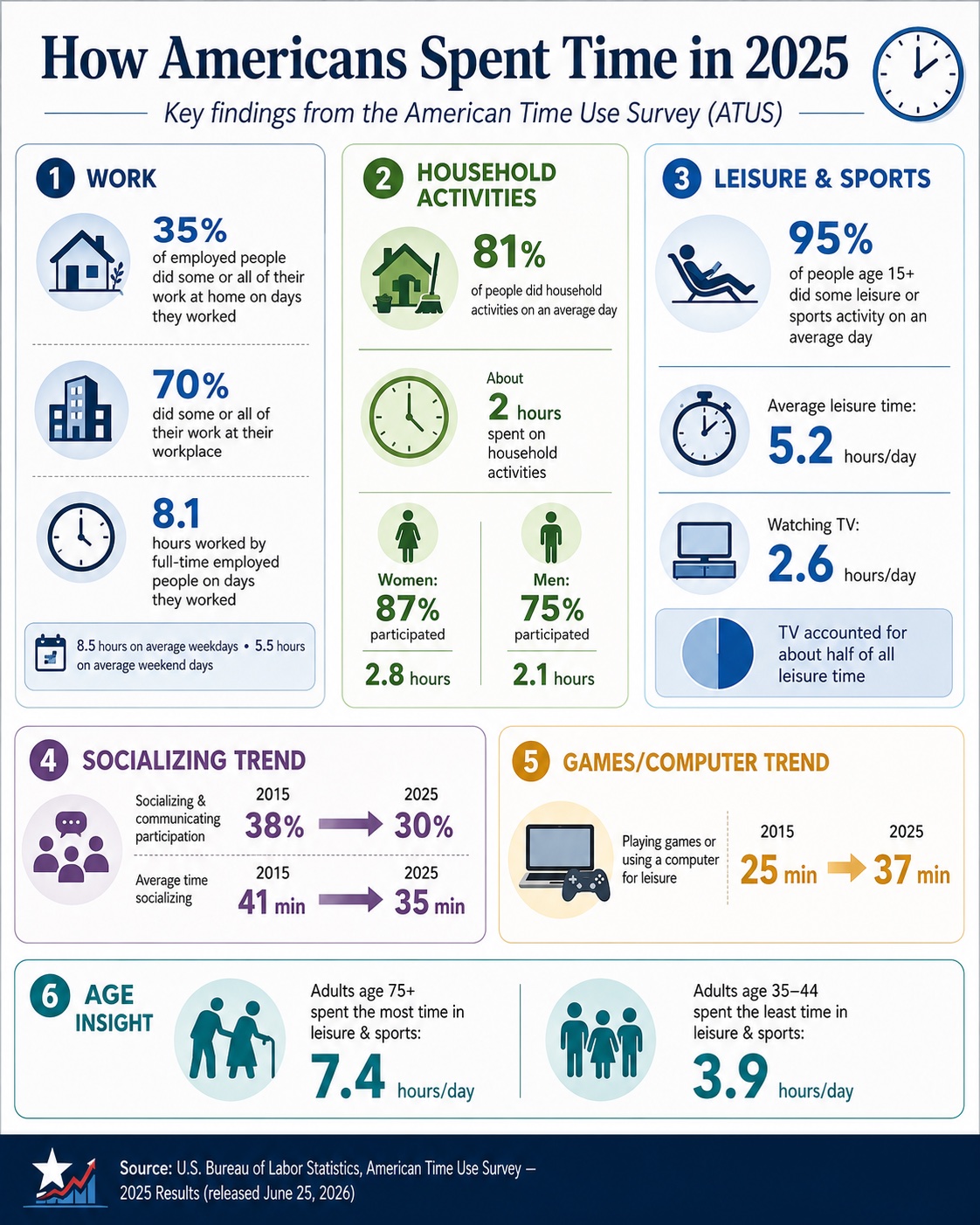
The freed time did not automatically become the run club, the standing Friday dinner or the long conversation at the store. Those require deliberate effort: chosen friction, scheduled in advance and slightly inconvenient.
The default was the path of least resistance, which can look like rest and still feel like a vacuum.
What changed was not only the amount of time.
Time switched categories.
The driver lived inside time. He had “free time to kill,” and you cannot kill a resource — only waste it. His generation treated time as a medium you existed in. My generation increasingly treats it as a resource to spend.
He worked until four and then hit a wall. The wall was the point: past it, no hour had to justify itself.
Delivery apps, smartphones and the always-on inbox did not simply add hours to his daughter’s day. They dissolved the wall.
Now every hour is potentially productive, so every idle one has to explain itself.
Frictionless Was a Differentiator. Now It Is the Entry Fee.
This is not only a philosophy problem.
It is a strategy problem.
For more than a decade, customer experience has been organized around removing friction: fewer fields, faster checkout, one-click purchasing, mobile ordering, automated service, contactless delivery.
Much of that was genuine progress. Customers should not have to repeat the same information three times, wait without an explanation, or navigate a company’s internal complexity.
But once everyone is fast, speed no longer explains why the customer should care about you.
A brand that trains customers to value only speed may discover that they become loyal to speed, not necessarily to the brand delivering it. When another provider becomes cheaper, faster or more convenient, there may be little emotional weight holding the relationship in place.
The question is not whether brands should bring inconvenience back.
It is what else disappeared when they removed it.
Starbucks: A Fast Lane and a Place to Stay
Starbucks is useful precisely because it shows both sides of the problem.
Its original advantage was never only coffee. It was the “third place”: neither home nor work, but somewhere customers could meet, read, work or simply be around other people without organizing an occasion.
Mobile ordering solved a real problem. It also helped turn some stores into beverage fulfillment centers: drinks waiting for people rather than people inhabiting the café.
Under its “Back to Starbucks” strategy, the company is now trying to unbundle the two jobs. It is improving pickup for customers who want speed while restoring seating, ceramic mugs, condiment bars, warmer interiors and visible coffee craft for those who want to stay.
The turnaround is still expensive and unfinished, so I would not present it as settled proof. But there is now real evidence of movement: in Starbucks’ second fiscal quarter of 2026, U.S. comparable-store sales rose 7.1% and transactions rose 4.3%.
At the same time, margins remained under pressure, partly because of the company’s large investment in staffing and the coffeehouse experience.
That tension is the point.
Load-bearing friction can create value, but it is not free. The strategic question is whether the resulting traffic, loyalty and differentiation justify the investment.
Barnes & Noble: The Browse Is the Product
Barnes & Noble may be an even cleaner example.
Amazon made buying a known book almost frictionless. Barnes & Noble’s recovery has not come from trying to beat Amazon at that job. It has come from making the physical store worth entering again.
The company has given local booksellers more influence over selection and layout, allowing stores to reflect their neighborhoods rather than operate as identical warehouses.
At the end of 2025, Barnes & Noble had reached 702 stores. Its CEO said business at existing stores remained strong and expected to open another fifty or sixty locations in 2026.
That does not prove that browsing alone caused the recovery. Cost controls, merchandising changes, BookTok and broader interest in physical bookstores have also played roles.
It does show that browsing, curation and physical discovery have not become obsolete simply because buying became easier.
In a bookstore, the “inefficiency” is often the value.
You go in for one title and leave with another. You notice what someone placed on a table. You ask a bookseller. You spend time without knowing in advance what the time will produce.
The browse is not friction surrounding the product.
The browse is part of the product.
Capital One: A Useful Experiment, Not Yet Proof
Capital One Cafés bring the idea back to the taxi driver’s bank.
Routine transactions remain digital, while the physical space is reassigned to conversation, guidance, work and financial education.
The concept is still expanding: Capital One operated 65 cafés at the end of 2025 and planned more for 2026.
This is a revealing design response: the ten-second transaction stays digital, while human presence is preserved for the moments in which it can carry more value.
Now Make the Journey Invisible
AI makes the question more urgent, but also more complicated than the usual “agents will buy everything” headline suggests.
Google is actively expanding its Universal Commerce Protocol, which allows AI experiences such as Gemini and AI Mode to connect discovery, product information, carts, loyalty and checkout.
OpenAI, meanwhile, now says it is moving away from a standalone Instant Checkout experience in ChatGPT and prioritizing product discovery followed by checkout on merchant-owned sites and apps.
The implementations differ.
The direction does not.
AI is compressing search, comparison and decision-making. Customers may encounter fewer websites, fewer catalogs and fewer branded journeys before choosing.
When those touchpoints disappear, what is left of the brand?
Whatever emotional residue it managed to leave.
Which is precisely the thing many companies have spent a decade optimizing out because it never appeared as a line item.
What Is the Friction Carrying?
Dead friction is a form that asks for information the company already has. A wait with no explanation. A surprise fee. A service process designed around departments rather than the customer’s problem.
Load-bearing friction gives something back. It is the browse that produces discovery, the wait that creates anticipation, the ritual that marks a transition, the conversation that builds confidence, the repeated visit that turns recognition into belonging.
Before removing a step, teams should ask:
- What burden does it create? How much time, confusion, effort or risk does it impose?
- What is happening inside it? Is it also carrying agency, reassurance, discovery, anticipation or human contact?
- Can we remove the burden without deleting the benefit? Can the fast lane and the place to stay coexist?
- What will replace the touchpoint? If the interaction carried trust or distinctiveness, where will those functions live after the optimization?
Sometimes the answer will be “nowhere,” because the step was carrying nothing.
Delete it.
But sometimes a company will discover that it has been billing the removal as savings while the customer pays for the loss somewhere off the ledger.
The taxi driver understood it. He does not want the past back. He does not want two-hour bank lines or a world without apps.
He wants the thing the past handed him without his ever having to ask: a reason to go somewhere, a familiar face, a small interruption to the private loop of work, home and screen.
The feeling that time did not merely pass efficiently, but held something.
So the next time your team celebrates an optimization that saves the customer twenty minutes, ask the question missing from the dashboard.
Not only:
How much time did we save?
But:
What are we saving that time for?
Load-bearing friction is one of the questions I now bring into Joy–Stress Audits and leadership workshops: what can be removed, what must be preserved, and what needs to be rebuilt elsewhere. For teams redesigning customer journeys around AI, automation or convenience, it is worth mapping before the next optimization ships.
The Joy Dividend is available for purchase on Amazon.
Originally published in The Joy Dividend on LinkedIn.