Every evening, the same question lands on my kitchen table:
"What's for dinner?"
It sounds simple. It is anything but.
In my family, four people are plant-based. Two want beef. One is allergic to dairy. One is sensitive to gluten. There are multiple ages, multiple appetites, and exactly one kitchen.

The "job" isn't making dinner. The job is making dinner that leaves everyone feeling satisfied — fed, considered, not like an afterthought. And if you've ever tried to solve that equation while also managing homework, work, and the general chaos of a weekday evening, you know: most nights, someone compromises. Someone settles. Someone eats cereal later.
I am living this daily, so I am also contemplating it as a strategist. Because this exact tension, the gap between what people actually need and what they settle for, is hiding in plain sight inside every product, service, and brand experience. And there's a framework that makes that gap visible.
The question most brands never ask
In the 1990s, Harvard Business School professor Clayton Christensen introduced an idea that changed how we think about innovation. He called it Jobs to Be Done.
The premise is deceptively simple: people don't buy products. They hire them to do a job. You don't buy a drill because you want a drill. You buy it because you want a hole in the wall. And if someone invented a way to hang a shelf without drilling, the drill would be out of a job.
JTBD flips the lens from "what are we selling?" to "what is the customer actually trying to accomplish?" It sounds obvious. It is not how most companies operate.
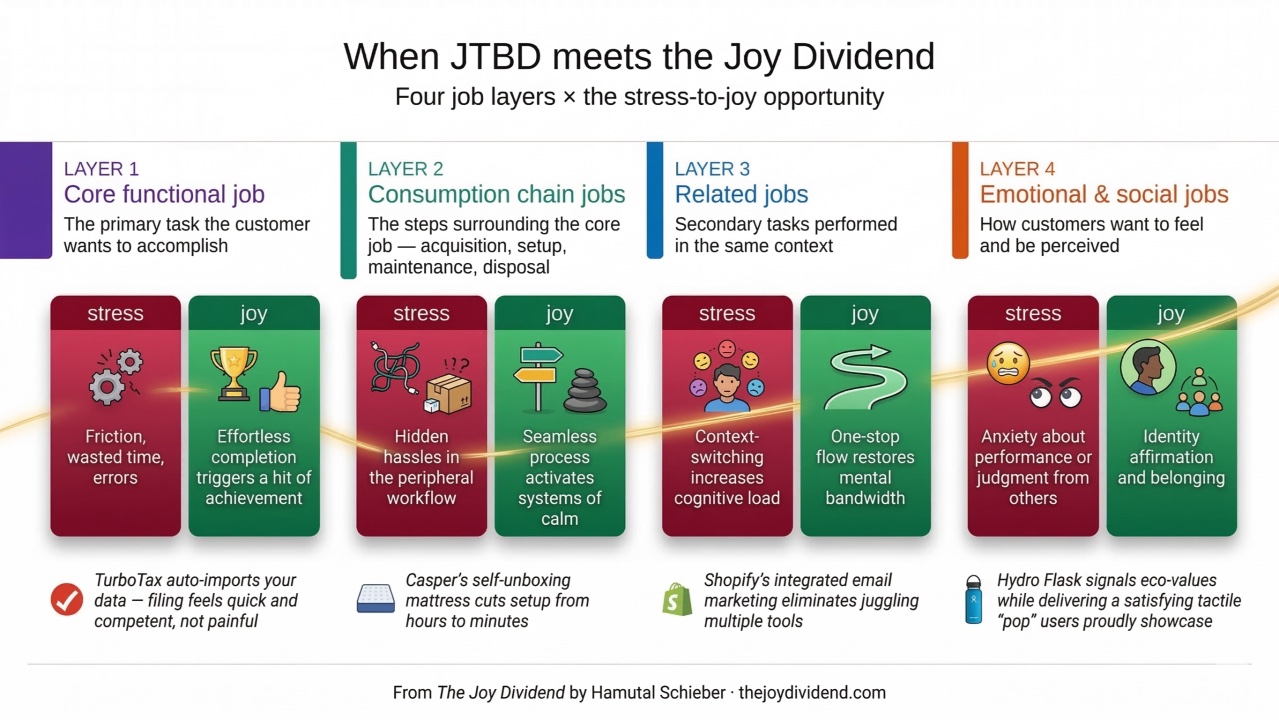
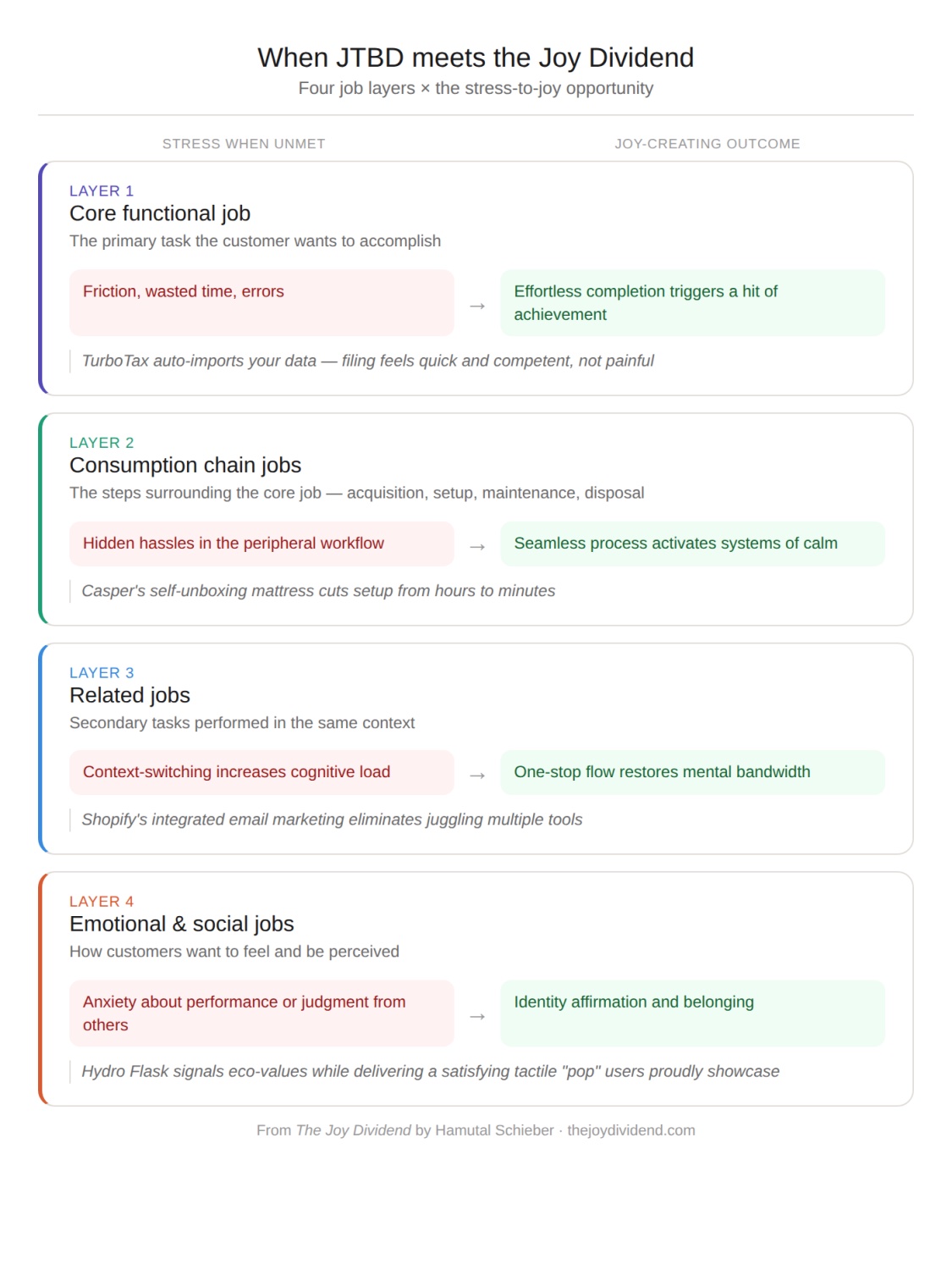
Tony Ulwick, who refined Christensen's thinking into a methodology called Outcome-Driven Innovation, took this further. He identified that every "job" actually has four layers — and most brands only see the first one.
Layer 1: The Core Functional Job. The primary task. For my family, that's a meal everyone will eat. For a tax filer, it's getting their return submitted accurately. When this job isn't done well, the result is friction, wasted time, errors. When it is done well, there's a genuine hit of accomplishment — that satisfying feeling of "done."
Layer 2: The Consumption Chain. The steps surrounding the core job — acquisition, setup, maintenance, cleanup. For dinner, this is grocery shopping, prep, cooking, dishes. These are the hidden hassles that drain you before the main event even starts. When they're seamless, your whole nervous system calms down.
Layer 3: Related Jobs. The secondary tasks performed in the same context. Dinner isn't just feeding people — it's managing schedules, coordinating timing, maybe packing tomorrow's lunches. Every time you switch between these tasks, your cognitive load increases. When a solution handles multiple related jobs in one flow, it restores mental bandwidth.
Layer 4: Emotional and Social Jobs. How people want to feel and be perceived. Here's the one most brands miss entirely. At my dinner table, the emotional job isn't "eat food." It's "feel like my needs matter." For others, it's "be seen as a nourishing mom". It's the difference between everyone tolerating a compromise meal and everyone feeling like somebody thought about them specifically.
Now. Look at these four layers and think about the businesses competing for my family's dinner.
I could buy different ingredients and cook different meals every evening. Honestly, it's what I end up doing most days.
A meal kit service addresses the core functional job — here's food — and simplifies some consumption chain steps. But it still assumes everyone's eating the same thing.
A takeout app lets me order from one restaurant, maybe two. But coordinating multiple orders from multiple places means I'm now the project manager of dinner. The related jobs multiply - as well as costs.
Most solutions get one or two layers right. Almost none get all four.
From diagnosis to strategy: Where the Joy Dividend comes in
JTBD tells you where to look. It reveals the layers of need most brands miss. But it doesn't tell you what to do once you see them.
That's the gap the Joy Dividend fills.
In my research, I've found that the brands creating the deepest loyalty aren't just removing friction — they're deliberately creating positive emotional states. They reduce the stress and spark something better. That's the dividend: the compound interest of customer love, earned by brands that consistently leave people emotionally better than they found them.
The business case is striking: research by Motista shows that emotionally connected customers have a lifetime value up to 306% higher, while Qualtrics XM Institute data indicates that customer effort is 1.8x more predictive of loyalty than satisfaction alone.
When you overlay the Joy Dividend onto the JTBD framework, the four job layers become a strategic map:
The core functional job is your entry stake. Nail it, or nothing else matters. But nailing it means going beyond "functional" to effortless — designing the experience so completion itself feels like a small reward.
The consumption chain is where the Calm Advantage lives. Every hidden hassle you eliminate, every peripheral step you smooth out, activates a sense of relief. Casper's mattress that unpacks itself. Amazon's one-click checkout. These aren't just conveniences — they're neurological gifts.
Related jobs are where you restore bandwidth. When Shopify added integrated email marketing, merchants didn't just save a step — they got back the mental energy they'd been spending on juggling tools. That's not efficiency. That's care.
And the emotional and social jobs? This is where brands go from dependable to beloved. This is where you move from solving problems to affirming identity.
This is exactly what Wonder understood
If you haven't encountered Wonder yet, you likely will soon. Now valued at over $7 billion, the company operates food halls featuring 20–30 restaurant concepts under one roof — Bobby Flay, José Andrés, Marcus Samuelsson, and more — all orderable in a single order, delivered in under 30 minutes.
Full disclosure: I have real problems with Wonder's broader communications and messaging. But that's precisely what makes this worth examining — because on this specific insight, they got it exactly right. And the JTBD lens shows why.
Wonder's entire premise maps to the dinner table problem I described. Their marketing literally opens with the pain point of families and friends who can never agree on what to eat. Their pitch isn't better food or faster delivery. It's: everyone gets exactly what they want, in one order, at the same time.
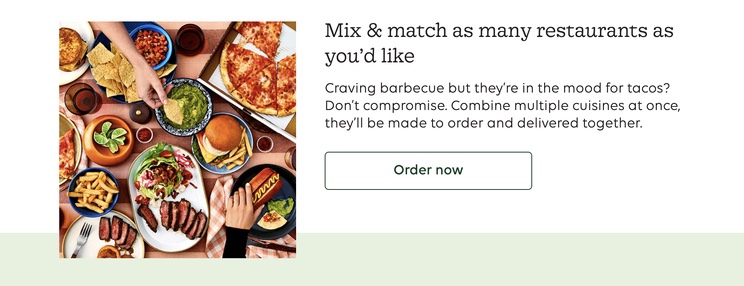
Core functional job: everyone eats something they actually chose. Consumption chain: one order, one delivery, no coordination gymnastics. Related jobs: no negotiation about whose restaurant "wins." Emotional job: nobody compromises. Everyone feels considered. (As for the social job, it varies).
Here's how they work with creators on this message:
Wonder didn't just solve the functional problem of dinner delivery. They solved the emotional problem of family mealtime — the feeling that someone's preferences always lose. That's a Joy Dividend play, even if they've never used the term.
This works in B2B too
Consider Canva vs. the traditional Adobe Creative Suite. Functionally, both let you design things. But Adobe was built for designers — powerful, complex, requiring real expertise.
Canva saw all four job layers. The core functional job (create a presentation or social post) was only the beginning. The consumption chain (learning curves, installation, file management) was exhausting for non-designers. The related jobs (brand consistency, team collaboration, resizing for different platforms) required separate workflows. And the emotional job — feeling like a competent, creative professional even if you're not a designer — was completely unmet.
Canva didn't just make design easier. They made non-designers feel capable. That's why marketing managers don't just use Canva — they evangelize it. That emotional job fulfillment is the engine of organic growth that no ad budget can replicate.
We see the exact same thing with Anthropic's Claude. The core functional job — get an answer, draft something, analyze data — is table stakes in the AI race. Every LLM does that. But Claude's differentiation lives in the other layers.
The consumption chain: no complex setup, no prompt engineering courses required, just a conversation.
Related jobs: research, editing, brainstorming, pressure-testing ideas, all in one flow instead of switching between six tools.
And the emotional job — this is the one that matters — feeling like you have a genuine thinking partner, not a vending machine you have to feed the right coins.
That's an emotional job most AI companies don't even know they should be solving for.
The question behind the question
JTBD gives us a powerful way to see what customers are really hiring us to do. But the framework's biggest gift might be the final layer — the emotional and social jobs that most companies treat as soft, unmeasurable, or secondary.
They're not secondary. They're the whole game.
Because when you ask "What's for dinner?" you're not really asking about food. You're asking: Will I be seen? Will my needs matter? Will this be one more thing I have to manage, or will someone make it easy for me?
Every brand faces a version of this question. The ones earning the Joy Dividend are the ones who hear what's really being asked.
I help companies find the hidden stress and opportunities for joy in their customer experience and turn it into loyalty, connection, and growth. If you want to explore where your brand's Joy Dividend lives, visit thejoydividend.com or connect with me at Schieber Research. My book, The Joy Dividend: How Brands Win by Reducing Stress and Sparking Delight, is available now.
Originally published in The Joy Dividend on LinkedIn.