
We Design Beginnings. Nobody Designs the End.
Argentina lost the World Cup final on Sunday.
By Monday morning, the emptiness did not belong only to Argentina. For 39 days the tournament had given millions of people something coming. Another match. Another argument. Another improbable outcome. People who rarely watch soccer had opinions. Strangers asked each other who they supported. Days had a shape.
Then the whistle.
Then nothing.
The feeling is easy to trivialize. It was only a sporting event. Only a series. Only a game.
But three separate research groups, working on television, video games and Olympic sport, have each built an instrument to measure the same shape of loss. As far as I can tell, none of them knew about the others.
What is this feeling? Post-Game Depression
In January, two Polish psychologists published the first quantitative measure of post-game depression in Current Psychology. Across two studies with 373 players, Kamil Janowicz and Piotr Klimczyk landed on four components:
- Persistent thoughts about the game
- Difficulty accepting that the experience was over
- A compulsion to replay it
- A reduced ability to enjoy other media.
Rumination was the strongest factor. Role-playing gamers were the most susceptible, which the researchers connected to how much influence those players have over the story and how strong a bond they form with the characters.
The more you shaped it, the worse the after.
They were not first. In 2019, Rita Kottasz and colleagues built a 15-item Post-Series Depression Scale, linking the melancholy after an absorbing series ends to emptiness, nostalgia and more compulsive patterns of consumption.
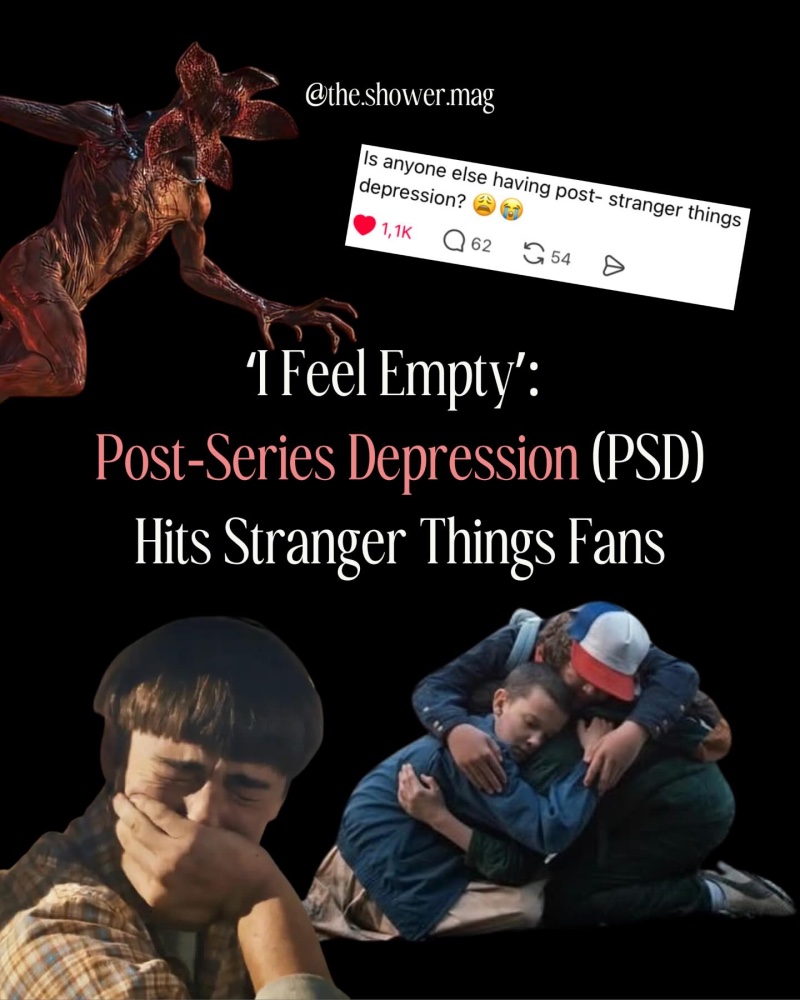
Neither term describes a psychiatric diagnosis, and the research does not establish one neat mechanism behind every empty feeling that follows an ending. But if you have experienced it, you recognize it immediately.
What nobody has built is a response.
What ends is the future
The obvious explanation is that we miss the pleasure. I do not think that is the most important part.
The peak-end rule explains how experiences are remembered: disproportionately through their most intense moment and through how they finished. But the flatness of the morning after is not primarily a memory problem.
For that, consider vacations. A 2010 study of 1,530 Dutch adults found that people with a vacation ahead of them were happier than those without one, apparently because they were already enjoying the anticipation. After the trip, that difference largely disappeared. Only those who had an especially relaxing holiday retained a modest, temporary lift.
The enjoyment of a holiday begins before departure. The enjoyment of a tournament begins before kickoff. A series is partly the knowledge that another episode is waiting. A game is partly the unopened portion of its world.
The World Cup's emotional value was never concentrated in the 106th minute. It was distributed across 39 days of having something coming: the next match, the next round, the next reason to text someone, the next chance for the story to change.
And on Monday the group chat did not die. It thinned. Someone posted a highlight, two people reacted, and nothing after that. By Thursday it'll be a graveyard of something that had been alive on Sunday.
When it ends, you do not only lose something you enjoyed. You lose a piece of the future. That may be why the feeling is so hard to locate. Sadness usually has an object; this is closer to the sudden absence of one. There is simply less in front of you.
A breakup nobody lets you have
Media psychology has a term for it, and it is not a metaphor: parasocial breakup.
People form real, one-sided attachments to players, performers, characters and fictional worlds. When the relationship is interrupted, because a series ends or an athlete retires or a game is completed, the resulting distress can resemble a diluted version of a reciprocal relationship ending.
The complication is that nobody grants you the loss. You cannot easily tell a colleague you are having a difficult week because fictional characters no longer have a future. So the feeling arrives with a second feeling attached, which is embarrassment at having the first one.
So we do not mourn. We rewatch, we keep reading analysis after there is little left to analyze, we start the game again, we ask the platform to replace the experience immediately.
And with the World Cup there was a further layer, because the attachment wasn't only to teams. Sociologists call it collective effervescence: the sense of connection and significance that comes from gathering around a shared ritual. Shira Gabriel's lab at Buffalo studied it across four studies of live music with 789 participants and found that these events produced an intertwined feeling of connection and sacredness, associated with greater meaning and wellbeing, still detectable a week later. People generally prone to it reported less loneliness even when they hadn't attended anything recently.
For 39 days, a temporary society existed. It had symbols, rituals, shared language, and one question capable of opening a conversation with almost anyone: did you see the game?
Then it dissolved. You were not only separated from the tournament. You were separated from the version of the world that had formed around it.
The number marketers should notice
One component of the post-game scale is called media anhedonia: a reduced ability to enjoy other media after finishing an absorbing one. It was the weakest of the four factors, so we should not overstate it, and the research is too new to tell us how durable or commercially significant the effect is.
But it raises a useful question. What happens when a campaign, premiere or launch scheduled immediately after a major cultural experience lands not on a clean slate, but on an audience still comparing everything to the world it has just lost? The resulting flatness gets recorded as underperforming creative. Perhaps the audience was simply not ready for a replacement.
The commercial value of anticipation is already clearer. In a randomized field experiment involving roughly 84,000 streaming viewers, releasing episodes gradually rather than all at once increased the likelihood that free-trial users would subscribe by 48% relative to the binge group. Gradual-release viewers also explored more of the catalogue and consumed more content overall. Netflix still releases about two-thirds of its originals in a single drop.
We know how to give people something to look forward to. We do it when there is a subscription attached.
Brands understand courtship
Beginnings are a solved problem. Countdowns, trailers, fan zones, prediction games, limited editions, watch parties, notifications — all of it manufactures anticipation and belonging, because those feelings increase involvement.
Then the event ends and the relationship is treated as commercially complete. The campaign stops. The space closes. The social team changes subjects. The platform recommends the next show, the game offers New Game Plus, the retailer announces another collaboration.
The assumption is that emptiness should be converted into a transaction as quickly as possible. But what people need after an ending may not be another beginning.
They may need help ending.
Bring a casserole
The obvious brand response is to say something emotional. That is usually the wrong instinct, and it will produce a thousand black-and-white posts about what an unforgettable journey this has been.
Consider what people actually do for someone in mourning. They bring food. A casserole makes no claim about understanding your inner life. It says: you do not have to cook tonight. That is why it comforts rather than intrudes.
And the casserole never comes from the family of the deceased. It comes from the neighbours.
The brand that ended the experience may be the worst-placed party to console anyone about it; its message sounds like an ex checking whether you are coping. The credible role belongs to the adjacent brand — the pub, the retailer, the local club, the community space, the app that had nothing to do with causing the ending and therefore nothing to gain from denying it.
That position is largely unoccupied. It is also cheap.
What separation design looks like
Convene rather than console. Research into parasocial grief points toward the value of social recognition. Put people in a room with others who understand the feeling, then get out of the way. A useful test: does the gesture point toward the brand, or toward the other people? If the brand is still the hero, it is an ex texting.
Build a bounded ending. Most campaigns do not end, they stop spending. A final recap, a closing screening, a fan archive, a keepsake, a place to record what it meant — and a finish date on all of it. Closure requires an edge.
Keep the people, not only the property. Watch groups can become local clubs. Spectators can become players. Online communities can continue under member leadership. The most valuable relationship an experience creates is often not between the customer and the brand. It is between customers.
Leave a next date. Not a rushed replacement. A smaller gathering, a recurring fixture, a reunion, an anniversary. Put something on the calendar, because the calendar is what went missing.
Walk people home
This is not only about the World Cup. It applies to conferences, festivals, finales, tours, immersive games, temporary retail and brand communities that quietly close.
We lavish attention on the emotional peak and measure it exhaustively: attendance, watch time, engagement, reach, sales. But an experience occupies the future before it happens and leaves a hole after it ends, and neither condition appears clearly on the dashboard.
The customer journey is not only discovery, purchase and use. It is anticipation, participation and separation.
Separation is the stage almost nobody has designed.
A good host does not invite people into an extraordinary evening, turn on the lights at midnight and disappear. They mark the ending. They help people say goodbye. They make sure nobody leaves alone.
We spend a great deal inviting people into cultural experiences. It may be time we learned how to walk them home.
The Joy Dividend is about what customers are feeling, not what they are clicking. www.thejoydividend.com
Originally published in The Joy Dividend on LinkedIn.